
Introduction
Choosing basmati rice for a restaurant is not simply about picking a familiar brand or the lowest price.
Different basmati rice grades, varieties and processing styles can behave differently in the kitchen. Grain length, aroma, texture, cooking performance and holding time can all affect the final dish.
For restaurants, caterers and food businesses in Singapore, choosing the right rice can improve consistency while helping control food costs.
Three terms commonly appear when buying basmati rice:
- 1121 basmati
- Sella basmati
- Regular basmati
However, these terms do not all describe the same thing.
1121 refers to a basmati rice variety, while Sella refers to a processing method. This means a rice can actually be both 1121 and Sella.
Understanding that difference makes it much easier to choose the right rice for your menu.
If you are sourcing larger quantities for a food business, you may also want to read our guide to basmati rice wholesale in Singapore.
What Makes Basmati Rice Different?
Basmati is known for its long, slender grains, distinctive aroma and ability to elongate during cooking.
The Agricultural and Processed Food Products Export Development Authority (APEDA) describes basmati as a long-grain aromatic rice traditionally grown in specific parts of the Indian subcontinent. Its characteristics include slender grains, elongation after cooking, aroma and a light, fluffy texture.
For restaurants, however, knowing that a rice is “basmati” is only the starting point.
Different varieties and processing methods can affect:
- Grain length
- Aroma
- Texture
- Grain separation
- Cooking time
- Resistance to breaking
- Performance during batch cooking
- Appearance after cooking
A restaurant preparing biryani may therefore choose a different basmati from a restaurant serving rice mainly with curry.
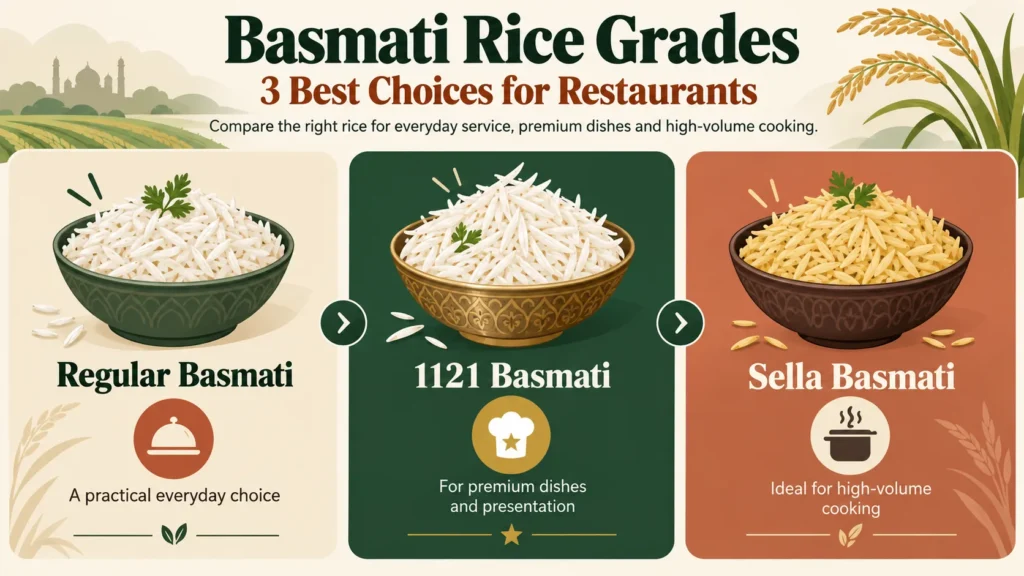
1. Regular Basmati Rice: A Practical Everyday Choice
Regular basmati rice can be a good option for restaurants that want the familiar aroma and long-grain characteristics of basmati without necessarily requiring exceptionally long grains.
It can work well when rice is served as an accompaniment rather than being the centrepiece of the dish.
Where Regular Basmati Works Well
Regular basmati may suit:
- Curry and rice meals
- Set meals
- Everyday restaurant service
- Staff meals
- Rice served with gravies
- Quick-service operations
For many food businesses, it provides a useful balance between quality and cost.
If the rice is mainly supporting a curry, sauce or protein, paying a premium purely for dramatic grain length may not always provide additional value to the customer.
When It May Not Be the Best Choice
Restaurants specialising in premium biryani or highly visual rice dishes may prefer a longer-grain option.
The important point is that a more expensive rice is not automatically the better rice.
The right choice depends on the dish.
2. 1121 Basmati Rice: When Grain Length and Presentation Matter
1121 is one of the best-known basmati varieties used in premium rice dishes.
APEDA identifies Pusa Basmati 1121 as a recognised basmati variety. Related APEDA varietal information also highlights the extra-long slender grain characteristics associated with the 1121 line.
Restaurants often consider 1121 when presentation is particularly important.
Where 1121 Basmati Can Work Well
1121 basmati is commonly suited to dishes such as:
- Biryani
- Pulao
- Premium rice platters
- Banquet dishes
- Signature rice dishes
- Special-event menus
When properly prepared, its long grains can create the visual separation associated with premium biryani.
For restaurants where rice is a major part of the customer’s first impression, this can matter.
Does Every Restaurant Need 1121?
No.
If the rice is being covered with curry or served as a simple side dish, the additional cost of a premium extra-long grain may not always be justified.
Restaurants should ask a more practical question:
Will the customer notice and value the difference?
If the answer is yes, a premium basmati may make sense.
If the answer is no, a more economical basmati may be the better commercial choice.
3. Sella Basmati Rice: Useful for High-Volume Cooking
Sella basmati is basmati rice that has undergone a parboiling process before milling.
This changes the structure of the grain and generally gives it a firmer texture.
For commercial kitchens, that can be useful.
Why Food Businesses Use Sella Rice
Sella basmati may be suitable when rice needs to be:
- Cooked in larger batches
- Used for catering
- Transported before service
- Held during buffet service
- Prepared for banquets
- Managed in a high-volume kitchen
Its firmer grain structure can make it useful where the rice needs to maintain separation during extended service.
Golden Sella and White Sella
Restaurants may encounter several types of Sella rice.
Golden Sella develops a yellow or golden appearance through processing and is often chosen for biryani or rice dishes where that appearance suits the presentation.
White or Creamy Sella offers the firmer characteristics associated with parboiled basmati while maintaining a lighter colour.
The correct choice depends on the restaurant’s cooking method, recipe and preferred appearance.
1121 and Sella Are Not Opposites
One of the most common sources of confusion is the assumption that a buyer must choose between 1121 and Sella.
That is not quite correct.
1121 describes the rice variety.
Sella describes how the rice has been processed.
That means you may encounter products described as:
- 1121 White Basmati
- 1121 Steam Basmati
- 1121 Golden Sella
- 1121 Creamy Sella
Understanding this distinction makes it easier to compare products accurately.
Instead of asking a supplier simply for “premium basmati”, a restaurant buyer can ask:
- What variety is the rice?
- Is it raw, steamed or Sella?
- What pack sizes are available?
- How does it perform in batch cooking?
- Is it suitable for the intended dish?
These questions are far more useful than relying on price alone.
Basmati Rice Grades: Quick Comparison
| Type | Main Strength | Suitable Uses |
|---|---|---|
| Regular Basmati | Good balance between quality and cost | Curry meals, everyday rice and staff meals |
| 1121 Basmati | Extra-long grain and strong presentation | Premium biryani, pulao and signature dishes |
| Sella Basmati | Firmer grain and good batch-cooking performance | Catering, buffets, banquets and high-volume kitchens |
| 1121 Sella | Long grain combined with Sella processing | Premium biryani, catering and banquet operations |
There is therefore no single basmati rice that is automatically best for every restaurant.
The right rice depends on how it will be used.
Which Basmati Rice Should Your Restaurant Choose?
A restaurant buyer can usually narrow the choice by answering four questions.
1. What Dish Are You Preparing?
If the rice is the centrepiece of the dish, presentation becomes more important.
A biryani restaurant may therefore place greater value on grain length and separation than a restaurant serving rice mainly with curry.
If your business uses several rice varieties, the Dashmesh basmati rice range provides examples of the different brands and pack sizes available.
2. How Much Rice Do You Cook at One Time?
A restaurant preparing small batches throughout the day has different requirements from a caterer preparing hundreds of portions at once.
For large-batch cooking, the ability of the rice to maintain its texture and grain separation may become more important.
This is one reason Sella rice can be useful in catering and banquet environments.
3. How Long Will the Rice Be Held Before Serving?
Rice served immediately after cooking does not face the same conditions as rice kept warm during a buffet or transported to an event.
Restaurants should test rice under their actual service conditions.
A rice that looks excellent immediately after cooking may perform differently after being held for a longer period.
4. What Is the Real Cost Per Portion?
Restaurants should not evaluate rice only by the price of the bag.
Consider:
- Purchase price
- Cooked yield
- Portion size
- Grain breakage
- Waste
- Consistency
- Customer expectations
The cheapest rice per kilogram is not necessarily the cheapest rice to serve.
A slightly more expensive rice may produce better yield or more consistent portions.
Similarly, using an expensive premium rice for a dish where customers cannot appreciate the difference may increase food costs unnecessarily.
For businesses trying to understand how much rice they actually need each month, Dashmesh’s restaurant rice usage calculation guide provides a practical method based on covers, portions, stock levels and trading days.
One Restaurant May Need More Than One Basmati Rice
There is no requirement for a restaurant to use the same rice for every dish.
In fact, using different rice for different applications can sometimes make more sense.
For example:
Premium Biryani
An extra-long grain basmati such as 1121 may provide the desired presentation and grain separation.
Catering or Buffet Service
A suitable Sella basmati may provide greater resilience during large-batch preparation and service.
Everyday Meals
A reliable regular basmati may offer better value where rice is mainly an accompaniment.
Staff Meals
A more economical rice may be perfectly suitable where premium grain appearance is not required.
This approach allows restaurants to match ingredient cost to the value each dish provides.
Test the Rice Before Ordering Large Quantities
Product descriptions and packaging can only tell you so much.
Restaurants should test rice under their own kitchen conditions before committing to a large order.
Prepare it using your usual:
- Cooking equipment
- Water ratio
- Soaking method
- Batch size
- Recipe
- Holding method
Then check:
- Grain length after cooking
- Grain separation
- Aroma
- Texture
- Breakage
- Yield
- Performance after holding
- Suitability with the actual dish
This is especially important because different kitchens use different cooking systems and preparation methods.
The rice should work in your kitchen, not simply look impressive on the bag.
Buying Basmati Rice in Bulk: What Else Should Restaurants Check?
Rice grade is only part of the purchasing decision.
For food businesses, supply reliability matters just as much.
When choosing a bulk rice supplier in Singapore, consider:
- Product consistency
- Availability
- Pack sizes
- Delivery reliability
- Lead times
- Storage requirements
- Product information
- Pricing
- Supplier responsiveness
A restaurant that relies heavily on rice cannot afford frequent substitutions or stock shortages.
This is why supplier reliability should be considered alongside the rice itself.
Restaurants sourcing a wider range of Indian ingredients may also find it more efficient to work with an Indian restaurant grocery supplier in Singapore that can supply rice together with spices, lentils, flour and other foodservice essentials.
Storage Matters When Buying Rice in Bulk
Buying larger quantities can reduce ordering frequency, but only if the rice is stored correctly.
Singapore’s warm and humid climate makes dry-food storage particularly important.
The Singapore Food Agency recommends keeping dried foods in a cool, dry place. It also advises transferring loose or unused contents from opened packages into airtight containers where appropriate.
Restaurants should:
- Keep rice away from moisture
- Store it in a clean, dry area
- Protect stock from pests
- Keep opened rice properly sealed
- Follow first-in, first-out stock rotation
- Avoid ordering more than can reasonably be stored and used
Good purchasing decisions should therefore consider storage capacity as well as price.
Choosing a Reliable Rice Supplier in Singapore
The lowest quoted price should not be the only consideration when selecting a supplier.
A food business also depends on consistent product quality and reliable deliveries.
A suitable supplier should be able to provide:
- A range of rice options
- Suitable foodservice pack sizes
- Consistent supply
- Clear product information
- Reliable deliveries
- Responsive support
- Competitive bulk pricing
Dashmesh supplies rice and a wider range of food products to restaurants, caterers, retailers and other businesses in Singapore.
Businesses comparing suppliers can also use the Dashmesh food supplier checklist to assess factors such as reliability, product range, delivery capability and service.
Basmati Rice Options Available from Dashmesh
Dashmesh carries a broad selection of basmati rice products from established brands and its own range.
The current basmati category includes products from brands such as Daawat, Lal Qilla and other rice brands in a variety of pack sizes.
Dashmesh’s own signature brands include Temasek Gold, which Dashmesh positions as its flagship premium long-grain basmati rice.
This gives restaurants and foodservice buyers the ability to compare different products based on their menu, usage and budget rather than relying on a single rice option.
The Best Basmati Rice Depends on the Job
Instead of asking:
“Which is the best basmati rice?”
Restaurants should ask:
“Which basmati rice is best for this dish and this type of service?”
Regular basmati can be an excellent everyday choice.
1121 can provide the extra-long grain presentation required for premium dishes.
Sella can be useful when rice needs to perform reliably during large-batch cooking, catering or extended service.
For some restaurants, the most efficient strategy may be to use more than one type of basmati rice.
By matching the rice to the dish, kitchen process and service format, food businesses can improve consistency while managing ingredient costs more effectively.
Looking for Basmati Rice Wholesale in Singapore?
Dashmesh supplies basmati rice to restaurants, caterers, retailers and other food businesses across Singapore.
Foodservice buyers can explore the full basmati rice product range or read our guide to buying basmati rice wholesale in Singapore for more information on quality, pack sizes and commercial purchasing.
The right rice is not necessarily the most expensive option.
It is the rice that works best for your menu, your kitchen and your customers.