
Introduction
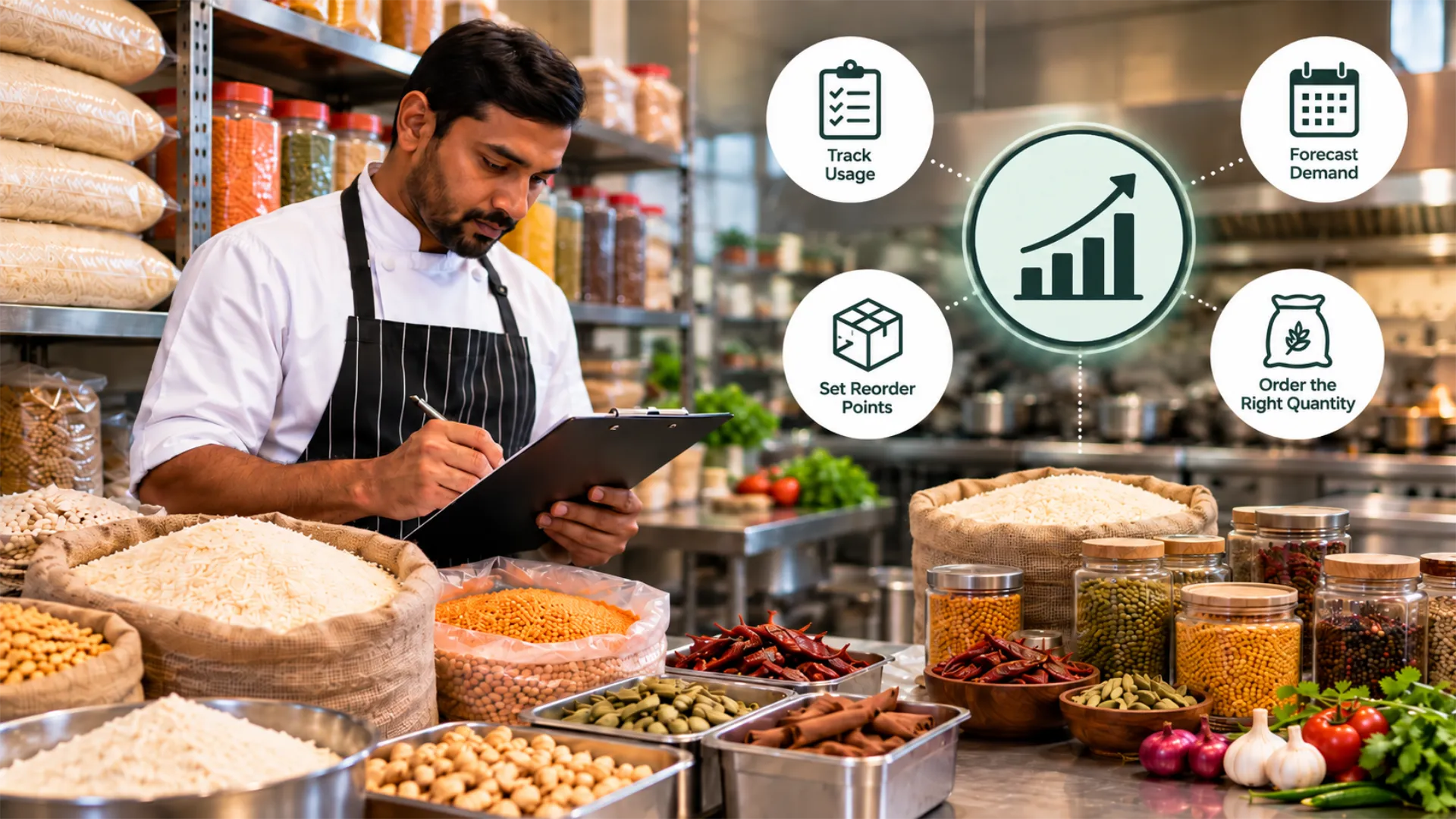
A reliable restaurant rice usage calculation replaces guesswork with a repeatable method based on customer covers, the share of customers choosing rice, measured raw rice per serving, trading days and usable stock. Too little stock can lead to emergency purchases, substitutions or menu disruption. Too much can tie up cash, occupy storage space and increase the risk of damaged or deteriorated stock.
Singapore’s National Environment Agency advises food businesses to assess demand before buying in bulk because any unit-cost saving can be outweighed if unused food must be discarded. The NEA Food Waste Minimisation Guidebook for Food Retail Establishments also recommends tracking food waste and improving inventory management. The calculation below turns those principles into a practical monthly rice consumption forecast.
This article focuses on quantity planning. For decisions about rice type, quality, pack formats and delivery reliability, refer to Dashmesh’s guide to planning and evaluating bulk rice purchases.
Core formula: monthly raw rice requirement (kg) = daily covers × rice selection rate × measured raw rice per serving (g) × trading days ÷ 1,000.
Restaurant Rice Usage Calculation: Start With Your Own Data
There is no reliable universal figure for how much raw rice every customer will consume. Portions differ by cuisine, menu format, side dishes, customer profile, service style and rice variety. A buffet, biryani outlet, thali restaurant and curry rice stall should not use the same assumption.
The strongest starting point is a short kitchen measurement exercise using the rice, equipment and serving tools already in use. Run it on normal trading days, not only during unusually busy or quiet periods.
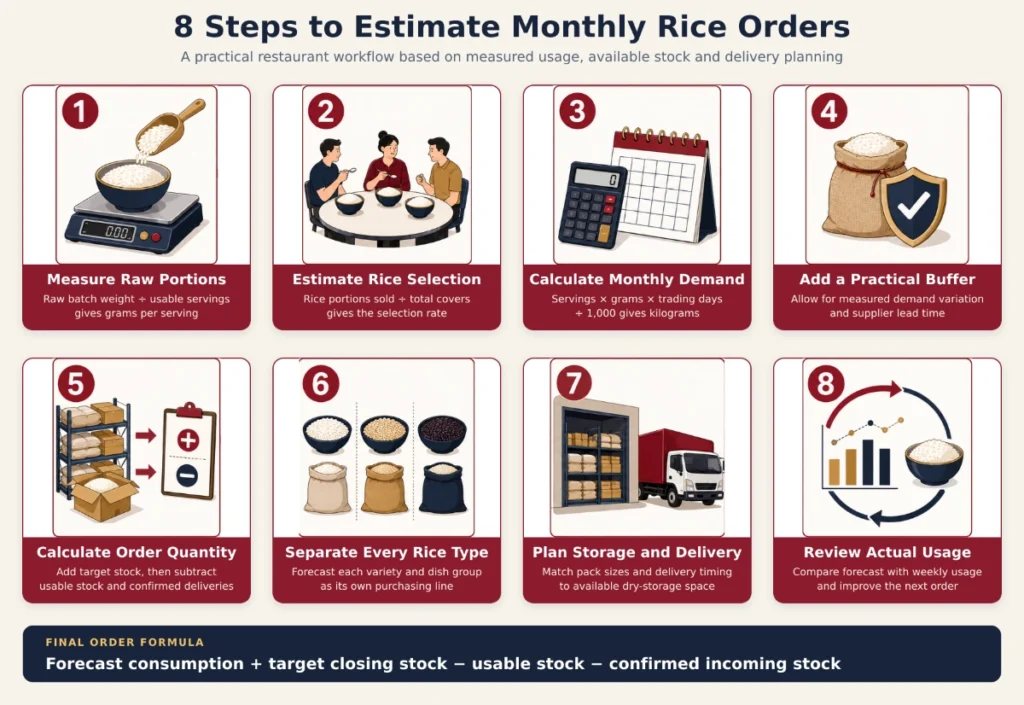
1. Measure Raw Rice Used Per Serving
For each rice dish or service format, record the dry rice placed into the cooker and the number of full, usable portions served from that batch. Use complete portions actually suitable for service. Do not count burnt rice, spillage, test portions or leftovers as saleable output.
Measured raw rice per serving = raw batch weight ÷ usable portions produced
Repeat the measurement across several batches. If the result changes significantly, investigate whether the cause is scoop size, recipe variation, water ratio, staff practice or customer demand. Use the restaurant’s own measured median or operating standard rather than copying a generic internet portion figure.
2. Forecast Consumption: Estimate How Many Customers Will Choose Rice
Total covers are not the same as rice portions. Some customers may choose bread, noodles or another side. Some may share rice while others may order extra. Calculate a rice selection rate from point-of-sale data, kitchen tickets or a manual count.
Rice selection rate = rice portions sold ÷ total covers
Where demand changes by day, calculate separate rates for weekdays, weekends, lunch and dinner. Also record staff meals, takeaway orders and catering trays if they are not already included in the point-of-sale count.
3. Calculate the Base Monthly Requirement
Multiply the expected number of rice servings by the measured raw rice used per serving and the number of trading days. If the restaurant closes on certain days, use actual service days rather than the number of calendar days in the month.
Base monthly requirement (kg) = expected rice servings per day × raw grams per serving × trading days ÷ 1,000
Worked Example: Restaurant Rice Usage Calculation
The example below shows the method. The figures are not recommended standards. Each restaurant should replace them with its own operating data.
| Input or calculation | Example | How it is used |
| Average covers per trading day | 120 | Based on recent normal trading data |
| Rice selection rate | 70% | 84 rice servings per day |
| Measured raw rice per serving | 90 g | Illustrative kitchen measurement only |
| Trading days in the month | 26 | Use actual scheduled service days |
| Base monthly requirement | 196.6 kg | 84 × 90 × 26 ÷ 1,000 |
| Illustrative operating buffer | 8% | 15.7 kg added for normal variation |
| Forecast requirement with buffer | 212.3 kg | 196.6 kg × 1.08 |
| Usable stock on hand | 35 kg | Count only sound, available stock |
| Confirmed incoming stock | 25 kg | Include deliveries already committed |
| Indicative new order quantity | 152.3 kg | 212.3 − 35 − 25 |
The final order must then be converted into the pack sizes actually available and balanced against delivery frequency and storage capacity. If rounding to a full pack creates excessive closing stock, consider a smaller order, mixed formats or staggered delivery rather than treating every rounded-up kilogram as genuine monthly demand.
4. Add a Buffer Based on Evidence, Not Habit
A buffer protects the kitchen against ordinary demand variation and delivery lead time. It should not become a permanent excuse to overstock. The right level depends on the restaurant’s observed sales variability, supplier lead time, storage conditions and the operational impact of running short.
- Use recent peak-to-average demand differences to estimate normal variation.
- Separate predictable events, promotions and catering bookings from the ordinary buffer.
- Reduce the buffer when reliable, frequent deliveries make large contingency stock unnecessary.
- Review the buffer after every month rather than carrying the same percentage indefinitely.
The worked example uses 8% only to demonstrate the arithmetic. It is not a universal recommendation.
5. Convert Forecast Consumption Into an Order Quantity
Order quantity = forecast consumption + target closing stock − usable stock on hand − confirmed incoming stock
Before using the formula, check the storeroom physically. Exclude opened bags with uncertain quantities, damaged packs, quarantined stock and stock allocated to confirmed events. A spreadsheet total is only useful when it matches usable inventory.
6. Calculate Each Rice Type Separately
A restaurant may use basmati for biryani, fragrant rice for set meals and ponni rice for another part of the menu. Combining them into one total can produce the correct number of kilograms but the wrong buying mix. Run the calculation separately for every material rice type, outlet or production kitchen.
- Map each rice type to the dishes that use it.
- Measure a separate raw portion or batch standard where recipes differ.
- Forecast portions by dish or menu group.
- Combine the totals only after each rice type has been calculated.
For rice selection and cooking tests, review Dashmesh’s rice product range and its guide to testing basmati rice for commercial use.
7. Match the Order to Storage and Delivery
The forecast tells you how much rice the business expects to consume. It does not automatically mean the whole amount should arrive at once. Consider usable dry-storage space, stock rotation, handling effort, delivery lead time and the condition of opened stock.
NEA’s food-waste guidance cautions that businesses should assess demand before ordering in bulk and work with suppliers so purchasing matches customer demand. A monthly forecast can therefore support weekly, fortnightly or staged deliveries, depending on the supplier arrangement and the restaurant’s storage capacity. The same discipline should be applied across other ingredients through documented bulk ordering best practices.
8. Review Forecast Against Actual Usage Every Week
A forecast improves only when planned and actual usage are compared. Record the opening stock, deliveries, closing stock and known write-offs for each rice type.
Actual usage = opening stock + deliveries − closing stock − documented transfers
Keep waste and damaged stock as separate recorded adjustments so they do not disappear inside the consumption figure. After four weeks, compare forecast with actual usage and investigate material differences. The answer may be a sales change, portion drift, unrecorded staff meals, production waste, stock-count error or a menu change.
Tracking these variances also supports restaurant food cost planning because a purchasing forecast is more useful when it can be compared with actual ingredient usage and documented waste.
Restaurant Rice Planning Data to Track Weekly
A restaurant does not need complicated software to begin. A basic worksheet can track:
- Date and service period.
- Total covers.
- Rice portions sold by rice type.
- Raw rice issued to the kitchen.
- Staff meals and catering quantities.
- Production waste or damaged stock.
- Opening and closing stock.
- Deliveries received.
- Events, promotions or unusual trading conditions.
Use at least several representative weeks before treating the result as a stable purchasing standard. Continue monitoring after menu, price, operating-hours or portion changes.
Common Rice-Ordering Errors
- Using total covers as rice portions: Apply the measured rice selection rate instead.
- Copying a generic serving size: Measure raw rice per usable portion in the restaurant’s own kitchen.
- Mixing all rice types into one forecast: Calculate each variety and menu use separately.
- Ignoring staff meals, takeaway and catering: Add them explicitly if they are outside ordinary cover data.
- Treating safety stock as consumption: Keep forecast usage, target closing stock and the operating buffer visible as separate figures.
- Counting unusable inventory: Exclude damaged, quarantined or already-allocated stock.
- Ordering for the average day only: Model weekdays, weekends and known peak periods where demand differs.
- Buying extra only to obtain a lower unit price: Compare the saving with storage, cash-flow and wastage risks.
Do Not Solve Overproduction by Keeping Cooked Rice Too Long
Procurement planning and cooked-rice safety are connected. Producing excessive rice can create pressure to keep leftovers beyond safe operating controls. The Singapore Food Agency’s cooked-rice safety guidance says rice should not remain in the temperature danger zone of 5°C to 60°C. If cooked rice is not used immediately, SFA advises chilling it promptly to below 4°C. Food kept hot should be maintained at 60°C or above, with the establishment’s approved food-safety procedures followed.
The safer operational response is to improve forecasting and prepare smaller batches according to demand. This article does not replace the establishment’s food-safety plan, staff training or regulatory requirements.
What to Send When Requesting a Rice Quotation
Once the calculation is complete, provide enough information for a meaningful discussion:
- Rice type or intended menu use.
- Estimated monthly requirement by rice type.
- Preferred delivery frequency.
- Available storage capacity.
- Required pack-size options.
- Planned start date and known peak periods.
- Outlet or delivery location details.
Businesses can use Dashmesh’s request-a-quote page to enquire about current rice availability, formats and ordering arrangements. Product availability and pack sizes should be confirmed at the time of enquiry.
Frequently Asked Questions
How much raw rice should a restaurant allow per customer?
There is no single figure suitable for every restaurant. Measure the raw rice used in a normal batch, divide it by the number of usable portions and repeat the test across representative services.
How do I calculate monthly rice consumption?
Estimate daily rice servings from covers and the rice selection rate. Multiply by measured raw grams per serving and trading days, then divide by 1,000 to convert grams to kilograms.
How much buffer stock should a restaurant keep?
Set the buffer from observed demand variation, supplier lead time, delivery reliability and the operational impact of a shortage. Review it regularly. A percentage used in an example should not be treated as a universal rule.
Should a restaurant order one month of rice at once?
Not necessarily. Monthly demand can be delivered in smaller scheduled quantities when storage capacity, stock rotation or cash flow make a single delivery unsuitable.
How should different rice varieties be calculated?
Calculate each rice type separately using the dishes, portion standards, trading pattern and existing stock relevant to that variety.
Why does forecast usage differ from actual stock movement?
Common causes include portion drift, stock-count errors, unrecorded staff meals, production waste, transfers, catering orders and unexpected sales changes.
Conclusion
A useful restaurant rice usage calculation begins with real kitchen measurements. Start with covers, determine how many customers choose rice, measure the raw amount used per serving and multiply by actual trading days. Then add an evidence-based buffer, subtract usable stock and confirmed deliveries, and convert the result into practical pack sizes and delivery intervals.
The method will not predict demand perfectly. Its purpose is to replace unsupported guesswork with a transparent forecast that can be checked and improved. That supports steadier kitchen operations, more disciplined purchasing and less avoidable waste.