
Introduction
Ghee for restaurants in Singapore is an important purchasing consideration for commercial kitchens preparing Indian and South Asian cuisine. From biryani and curries to traditional sweets, ghee contributes a distinctive aroma, rich flavour and smooth finish. Choosing the right product involves more than comparing prices. Quality, packaging, consistency and storage requirements all influence purchasing decisions.
Buying ghee in bulk can be a practical option for restaurants and caterers that use it regularly. However, larger quantities do not automatically translate into better value. The right choice depends on menu requirements, consumption patterns and how efficiently stock can be managed.
This guide explains what restaurants should look for when sourcing ghee, how to compare available packaging options and how to plan purchases around their kitchen’s requirements.
Why Ghee Matters in Commercial Kitchens
Ghee is a form of clarified butter produced by removing water and milk solids from butter or cream. The resulting concentrated dairy fat has a characteristic flavour and can be used in several cooking applications.
In Indian restaurants, ghee is commonly used for tempering spices, preparing rice dishes, enriching curries and making desserts such as halwa and laddoo. Its aroma and richness can influence the final flavour of these dishes.
Ghee also has a higher smoke point than ordinary butter, making it useful for cooking at relatively high temperatures. As explained in Healthline’s comparison of ghee and butter, removing water and milk solids changes how ghee behaves during cooking.
However, ghee is rich in saturated fat and should be used in moderation as part of a balanced diet. Its culinary advantages do not necessarily make it nutritionally healthier than butter.
For commercial kitchens, the main considerations are flavour consistency, cooking performance, ingredient suitability and cost.
What Grade of Ghee Should Restaurants Look For?
Terms such as premium, pure and high-quality frequently appear in food marketing. Restaurant buyers should look beyond these descriptions and examine the product’s actual composition and specifications.
1. Pure Dairy Ghee
Genuine ghee is produced from dairy fat. In Singapore, Regulation 125 of the Food Regulations defines ghee as clarified fat obtained by removing water and non-fat solids from butter or cream.
The regulation establishes quality requirements, including a maximum moisture content of 0.3% by weight.
This is a product standard, not a grading system that automatically designates one brand as superior to another.
When evaluating a product, restaurant buyers should check its ingredient declaration, product specifications and labelling.
Products marketed as vegetable ghee or alternative cooking fats should not automatically be treated as equivalent to pure dairy ghee. Their ingredients and cooking characteristics may differ.
2. Milk Source and Flavour
Ghee may be produced using different dairy sources, including cow’s milk and buffalo milk. The source, processing method and brand formulation can influence its flavour, aroma and texture.
Cow’s milk ghee is commonly used in Indian cooking and traditional desserts. However, restaurants should assess individual products rather than assume that a particular milk source is always better.
For kitchens preparing signature dishes, a small cooking trial can help determine whether the ghee delivers the desired taste and consistency.
3. Product Labelling and Traceability
Restaurant buyers should check that the packaging provides the necessary product details, including ingredient information, net quantity, applicable date markings and storage instructions.
As a dairy-derived ingredient, ghee also warrants attention to milk-allergen information. The clarification process removes most milk solids, but ghee should not automatically be regarded as safe for people with milk allergies.
Choosing a product with clear labelling and reliable specifications helps kitchens maintain consistency in purchasing and preparation.
Choosing the Right Ghee Packaging for Your Restaurant
One of the most important decisions when purchasing ghee in bulk is selecting a packaging size that matches actual consumption.
Smaller tins may be easier to handle and rotate, while larger containers can reduce the frequency of replenishment for kitchens with substantial demand.
Dashmesh Singapore lists several packaging options under its Leila Ghee product range.
Smaller Packs: 400g, 800g and 1.6kg
Leila Pure Ghee in 400g, 800g and 1.6kg packs provides options for kitchens that use moderate quantities or prefer smaller containers.
These formats may be suitable for restaurants with selected ghee-based dishes, dessert preparation areas or kitchens evaluating a product before committing to a larger purchase.
Smaller containers can also make stock rotation and portion control more manageable.
Larger Packs: 10-Litre Containers
For kitchens with greater consumption requirements, Dashmesh also lists Leila Pure Ghee in a 10-litre container.
This format may be worth considering for restaurants, catering operations and other foodservice establishments that use ghee regularly.
Before ordering, buyers should evaluate available storage space, handling requirements and how quickly the container will be used after opening.
The largest available pack is not necessarily the most economical choice. Restaurants should compare the quoted cost per equivalent quantity, while accounting for storage, wastage and ordering frequency. Where products are labelled in different units, such as kilograms and litres, the correct product-specific conversion is needed before comparing prices.
Five Things to Check Before Buying Ghee in Bulk
A structured purchasing process can help restaurants avoid unnecessary costs and interruptions.
1. Consistency of Quality
A change in ghee can affect the aroma and flavour of dishes, particularly those in which ghee is a prominent ingredient.
Restaurants should consider testing the product in commonly prepared dishes before switching brands or ordering larger quantities.
2. Packaging and Handling
Select packaging that kitchen staff can open, handle and store safely.
Consider whether the container allows hygienic dispensing and whether smaller quantities would be more convenient for different preparation stations.
3. Shelf Life and Storage Requirements
Check the product’s date markings and storage instructions before purchasing.
The remaining shelf life should be appropriate for the quantity being ordered. A discounted large container offers little benefit if the kitchen cannot use its contents while maintaining acceptable quality.
4. Pricing and Total Purchasing Cost
Compare quotations based on equivalent product quantities rather than container prices alone.
Restaurants should also consider order quantities, delivery arrangements, storage requirements and the potential cost of unused stock.
For a wider discussion of purchasing decisions, Dashmesh’s guide to bulk ordering best practices explains how businesses can approach larger ingredient orders.
5. Replenishment and Product Availability
For ingredients used in regular menu items, continuity of supply is important.
Before committing to an ordering arrangement, discuss current stock availability, the ordering process and any applicable minimum quantities or delivery conditions with the supplier.
This helps restaurants plan purchases around their operational requirements.

How Much Ghee Should a Restaurant Order?
There is no universal quantity of ghee that every restaurant should purchase. Consumption varies depending on menu composition, preparation methods, customer demand and portion sizes.
A restaurant specialising in biryani, rich curries and ghee-based desserts may use considerably more than one that includes only a few such dishes.
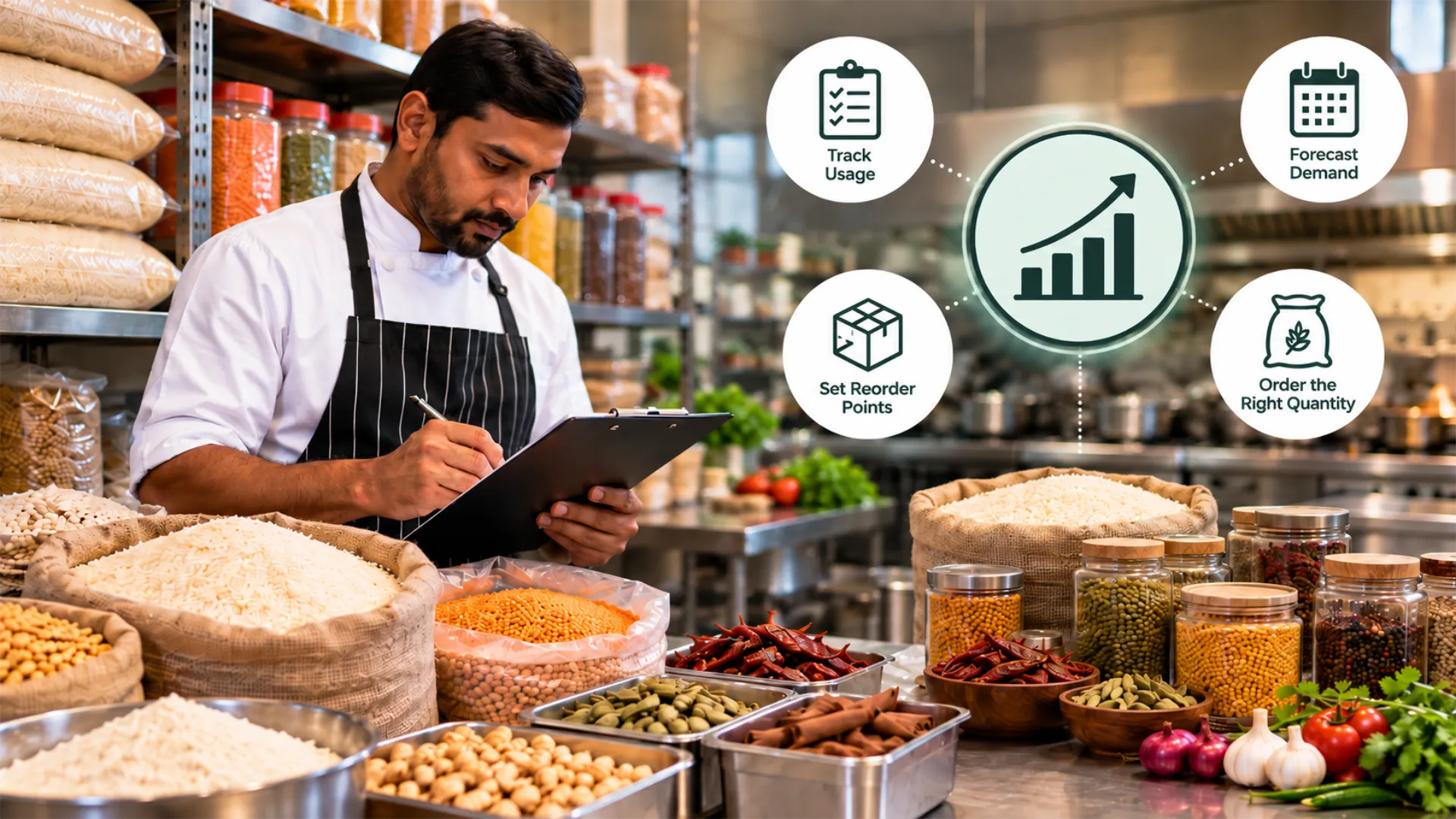
Rather than relying on estimates based solely on the number of customers served, kitchens should track actual usage.
A simple approach is to record opening stock, quantities received and closing stock over a defined period, making adjustments for wastage and other stock movements.
For example, if a kitchen begins the week with 4kg of ghee, receives another 2kg and finishes with 3kg, its recorded consumption is approximately 3kg for that week, assuming there are no other adjustments.
Repeating this exercise over several weeks provides a more useful basis for determining an average ordering quantity.
Restaurants can then consider supplier lead times, expected menu demand and a reasonable buffer before deciding how much to purchase.
Dashmesh’s article on restaurant inventory management in Singapore provides additional guidance on stock monitoring and purchasing decisions.
How to Store Ghee in Singapore’s Climate
Although ghee contains substantially less moisture than butter, storage conditions remain important for preserving its quality.
Singapore’s warm and humid conditions make appropriate food storage and hygienic handling particularly relevant.
The following practices can help commercial kitchens manage their ghee supplies:
- Follow the product label. Observe the manufacturer’s recommended storage conditions, including any instructions for use after opening.
- Limit exposure to heat and light. Keep containers in a suitable storage area away from direct sunlight and unnecessary heat.
- Use clean, dry utensils. Avoid introducing water, food particles or other contaminants into the container.
- Close containers properly. Reseal opened packaging according to the manufacturer’s instructions.
- Record opening dates. Label opened containers where appropriate and incorporate them into the kitchen’s stock rotation system.
- Inspect before use. Check for unusual odours, visible contamination or other signs of deterioration.
The Singapore Food Agency’s guidance on food labels and storage instructions explains why businesses should pay attention to storage directions and date markings.
Refrigeration requirements depend on the product and its manufacturer’s instructions. Restaurants should not apply a blanket rule that all ghee must or must not be refrigerated.
Similarly, a fixed shelf-life estimate should not replace the dates and directions provided for the particular product.
Where to Source Ghee for Restaurants in Singapore
Restaurants seeking a regular supply of ghee should consider working with a food supplier that can provide relevant product information and suitable ordering options.
Dashmesh Singapore supplies food products to restaurants, hotels, retailers and other businesses across Singapore.
Among its product offerings is Leila Pure Ghee, a cow’s milk ghee described by Dashmesh as having a rich buttery flavour and smooth texture.
The range listed on Dashmesh’s website includes 400g, 800g and 1.6kg packs, as well as a 10-litre container.
These options allow food businesses to enquire about formats appropriate for their consumption and operational needs.
Before purchasing, restaurants can discuss available pack sizes, quantities, pricing and ordering arrangements with the Dashmesh team.
Frequently Asked Questions About Buying Ghee in Bulk
Is buying ghee in bulk cheaper than purchasing smaller tins?
Larger packaging may offer a lower cost per equivalent quantity, but the actual saving depends on quoted prices, consumption and storage requirements. Restaurants should compare the total cost and avoid purchasing more than they can reasonably use.
What type of ghee is suitable for Indian restaurants?
Pure dairy ghee is widely used in Indian cooking, but suitability depends on the dish and desired flavour. Buyers should review product specifications and, where possible, assess the product through a cooking trial.
How long can an opened container of ghee be stored?
Storage conditions and the period for which quality can be maintained depend on the specific product and handling conditions. Follow the manufacturer’s instructions and avoid relying on a general rule for all brands and pack sizes.
Should restaurants buy ghee in kilograms or litres?
Both weight-based and volume-based packaging are available. Buyers should confirm the net quantity and use the correct product-specific conversion when comparing prices across different measurement units.
Where can restaurants enquire about Leila Ghee in Singapore?
Dashmesh Singapore lists Leila Pure Ghee in multiple packaging sizes. Restaurants and caterers can contact the company to enquire about current product availability, pricing and purchasing arrangements.
Enquire About Leila Ghee for Your Restaurant
Selecting the right ghee for a commercial kitchen requires more than comparing prices. Product consistency, suitable packaging, storage practices and realistic purchasing quantities all contribute to more efficient kitchen operations.
For restaurants and caterers looking to source Leila Pure Ghee in Singapore, Dashmesh offers a range of listed packaging options, from smaller tins to larger containers.
Contact Dashmesh Singapore to enquire about Leila Ghee pack sizes, current availability and bulk purchasing options for your foodservice business.