
Introduction
Effective restaurant inventory management Singapore food businesses can rely on is not about keeping the storeroom full. It is about maintaining enough of the right ingredients to support service without carrying more stock than the business can reasonably use.
For restaurants buying rice, lentils, flour, spices, nuts and other ingredients in bulk, poor inventory planning can create problems at both ends. Too little stock can interrupt service or force urgent purchases. Too much can tie up working capital, occupy valuable storage space and make stock rotation harder.
A practical inventory system should answer four basic questions:
- What are we actually using?
- When should we reorder?
- How much should we order?
- What could change before the next delivery arrives?
The following seven steps provide a practical framework for restaurants, caterers and foodservice businesses.
1. Track Actual Usage for Better Restaurant Inventory Management
The first step is to understand what the kitchen actually consumes.
Purchase history alone does not show consumption.
A restaurant may have purchased 200 kg of rice last month but still have 50 kg remaining. Another may have purchased less because it started the month with excess stock.
A simple calculation is:
Stock Depletion = Opening Stock + Deliveries + Transfers In – Closing Stock – Transfers Out
For example:
Opening rice stock: 60 kg
Deliveries: 100 kg
Closing stock: 35 kg
60 kg + 100 kg – 35 kg = 125 kg depleted
However, stock depletion does not automatically equal food sold to customers.
Restaurants should record significant waste, damaged stock, samples, staff meals and stock adjustments separately where possible.
This allows management to compare:
Expected ingredient usage based on sales
with
Actual physical stock movement
Large unexplained differences should be investigated.
How much historical data should you use?
There is no universal minimum.
Several representative weeks of reliable data can already improve purchasing decisions. Six months provides a stronger operating baseline. Twelve months is useful for identifying annual seasonality while two years allows year-on-year comparison.
Reliable records are more valuable than a large quantity of incomplete data.
2. Link Menu Sales to Restaurant Stock Forecasting
The second step is to connect ingredient usage with what customers actually order.
If biryani sales increase while bread-based dishes decline, rice consumption may rise even if total customer numbers remain unchanged.
Restaurants should therefore identify which menu items drive the use of major ingredients.
| Ingredient | Common Uses | Inventory Consideration |
|---|---|---|
| Basmati rice | Biryani, pulao, rice sets | Measure high-volume usage closely |
| Lentils | Dal dishes, curries, soups | Track important varieties separately |
| Atta and flour | Chapati, roti and breads | Connect usage to bread sales |
| Ground spices | Curries, marinades, sauces | Usage differs greatly by spice |
| Whole spices | Rice dishes, tempering, curry bases | Often slower-moving |
| Nuts and dried fruits | Desserts, biryani, garnishes | Higher-value stock deserves closer control |
Generic online serving sizes should not replace measurements taken in the restaurant’s own kitchen.
Dashmesh’s guide to restaurant rice usage calculation explains how customer covers, rice-selection rates and measured raw portions can be converted into purchasing estimates.
The same method can be applied to other ingredients.
If a standard batch of dal uses 4 kg of lentils and produces about 80 normal portions, that provides a much stronger basis for forecasting than a generic assumption about average consumption.
3. Set Reorder Points for More Reliable Bulk Food Ordering
The third step is to determine when the restaurant should place its next order.
A practical formula is:
Reorder Point = Average Daily Usage × Replenishment Lead Time + Safety Stock
Suppose a restaurant uses an average of 12 kg of basmati rice per day.
If replenishment normally takes two days and the restaurant has determined that 7 kg is an appropriate safety buffer:
12 kg × 2 days + 7 kg = 31 kg
The reorder point is therefore approximately 31 kg.
When usable stock approaches that level, the restaurant should consider placing its next order.
Reorder point is not target stock
Suppose the same restaurant wants approximately 14 days of rice available after replenishment.
12 kg × 14 days = 168 kg
The 168 kg figure is the restaurant’s target stock level.
It is not the reorder point.
| Measure | What It Tells You |
|---|---|
| Reorder point | When should we order? |
| Target stock level | How much stock do we want after replenishment? |
| Order quantity | How much should we purchase now? |
| Safety stock | What buffer do we need against uncertainty? |
Supplier lead times should come from the restaurant’s actual supplier arrangements rather than generic assumptions.
Delivery schedules can vary according to supplier, product, order size and period.
4. Calculate Order Quantities for Bulk Indian Grocery Singapore Purchases
The fourth step is to determine how much to purchase.
Using the previous rice example:
Reorder point: 31 kg
Average daily usage: 12 kg
Lead time: 2 days
Expected usage before delivery: 24 kg
If demand behaves as expected, approximately 7 kg should remain when the next delivery arrives.
If the restaurant wants to restore inventory to 168 kg:
Indicative Order Quantity = Target Stock – Expected Stock at Delivery
168 kg – 7 kg = 161 kg
The indicative order quantity is therefore around 161 kg.
The actual order should then be adjusted according to:
- Supplier pack sizes
- Confirmed incoming orders
- Upcoming catering bookings
- Storage capacity
- Expected demand changes
- Current pricing
These figures are illustrative. They do not mean every restaurant should maintain 14 days of rice or use 7 kg of safety stock.
Consider pack sizes carefully
If the calculated requirement is 42 kg and the product is supplied in 25 kg bags, purchasing 50 kg may be reasonable.
Ordering 75 kg simply because another full bag is available may not be.
Restaurants reviewing procurement more broadly can also read Dashmesh’s guide to choosing an Indian restaurant grocery supplier in Singapore.
5. Forecast Seasonal Demand for Better Restaurant Stock Planning
The fifth step is to adjust normal forecasts when demand is likely to change.
Historical averages are useful, but they should not be treated as fixed predictions.
Demand may change because of:
- Catering bookings
- Public holidays
- Festive periods
- Promotions
- Corporate events
- Group reservations
- Menu changes
- Changes in opening hours
Known demand should be incorporated first.
A simple framework is:
Expected Demand = Baseline Demand + Confirmed Additional Demand + Evidence-Based Seasonal Adjustment
If a restaurant already has a confirmed catering booking for 200 guests, that is a stronger forecasting signal than simply assuming a weekend will be busy.
Check current festive dates
Restaurants may experience changing demand around periods such as Deepavali or Hari Raya, but these dates should not be hard-coded into the same month each year.
The Ministry of Manpower’s official public holiday calendar should be checked during planning.
Restaurants with sufficient historical data can compare previous festive periods.
Newer restaurants should avoid applying large seasonal multipliers unless there is evidence to support them.
After the period, compare:
Forecast Usage vs Actual Usage
Significant differences may result from changes in customer demand, portion sizes, stock-count accuracy, waste or menu mix.
Restaurant stock forecasting should improve as these differences are understood.
6. Manage Inventory by Product Type to Control Restaurant Food Costs
The sixth step is to recognise that different ingredients need different inventory policies.
Applying the same stock target to every product can create unnecessary inventory.
Basmati rice
For restaurants buying basmati rice wholesale in Singapore, purchasing should consider:
- Actual usage
- Rice variety
- Pack size
- Storage capacity
- Delivery frequency
- Upcoming events
High-volume restaurants may rotate large quantities quickly while lower-volume businesses may benefit from smaller, more frequent purchases.
Lentils
Important lentil varieties should be monitored separately where usage differs materially.
Combining toor dal, urad dal, chana dal and other varieties under one inventory figure can hide shortages in one SKU and excess stock in another.
Flour
Atta, besan and maida may have very different usage patterns depending on the menu.
Purchasing should reflect actual kitchen demand rather than treating all flour as a single category.
Spices
Chilli powder, cumin and coriander may move quickly while speciality whole spices may turn over much more slowly.
Restaurants sourcing a wider selection can refer to Dashmesh’s guide to choosing an Indian spices supplier in Singapore.
Nuts and dried fruits
Nuts and dried fruits may represent relatively high-value inventory.
Holding unnecessary quantities can therefore tie up more working capital.
Dashmesh’s guide to dry fruits and nuts wholesale Singapore covers product quality, packaging, grades and bulk purchasing considerations.
Managing products according to their actual turnover can also support better restaurant food cost management.
7. Combine Safe Storage With a Reliable Restaurant Food Supplier Singapore Strategy
The seventh step is to connect inventory planning with storage and supplier performance.
A restaurant may calculate the correct order quantity but still face problems if products are stored incorrectly or replenishment is unreliable.
Follow product-specific storage instructions
There is no credible universal shelf-life figure that applies to every rice, lentil, flour or spice product.
Shelf life can vary according to:
- Product
- Packaging
- Manufacturer
- Storage conditions
- Whether packaging has been opened
Restaurants should follow the storage and durability information provided for the actual product.
The Singapore Food Agency’s food safety guidance provides guidance on appropriate food storage and temperature control.
Use FIFO and FEFO
A First In First Out (FIFO) system helps businesses use older stock before newer deliveries.
Where expiry dates differ, First Expired First Out (FEFO) can also help prioritise stock that should be used sooner.
Physical organisation matters.
If older products are hidden behind newly delivered cartons, even a good inventory system may fail in practice.
Reduce avoidable food waste
Singapore’s National Environment Agency food waste guidance places food-waste prevention at the top of its management hierarchy.
Better forecasting, ordering and stock rotation can help food businesses prevent unnecessary excess before disposal becomes necessary.
Factor supplier reliability into inventory planning
Supplier performance influences how much contingency stock a restaurant may need.
Purchasing teams should understand:
- Normal order cut-off times
- Delivery schedules
- Available pack sizes
- Minimum-order requirements where applicable
- Procedures when products are unavailable
- Peak-period delivery arrangements
Dashmesh’s Food Supplier Checklist Singapore provides a broader framework for evaluating suppliers beyond price.
A dependable restaurant food supplier Singapore relationship can help restaurants plan replenishment with greater confidence.
Putting the 7 Restaurant Inventory Management Steps Together
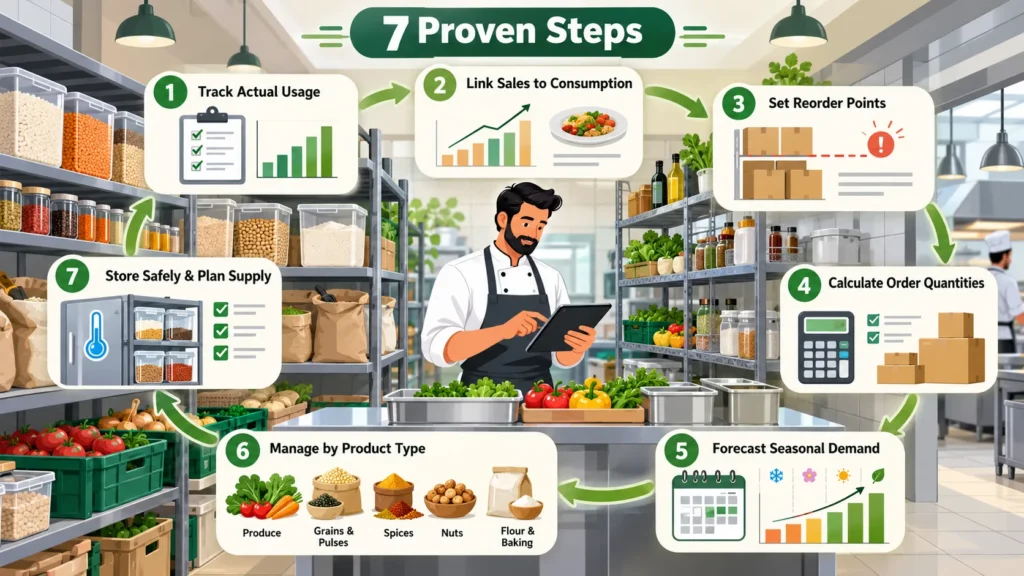
The seven-step process can be summarised as:
- Track actual ingredient usage
- Link menu sales to ingredient consumption
- Set reorder points
- Calculate appropriate order quantities
- Adjust forecasts for seasonal and confirmed demand
- Manage inventory according to product type
- Combine safe storage with reliable supply
The steps work together.
Usage data provides the baseline.
Menu sales help explain why consumption changes.
Reorder points determine when purchasing should begin.
Order quantities determine how much stock should arrive.
Forecasting accounts for future changes.
Product-level management prevents slow-moving inventory from being overlooked.
Storage and supplier performance help ensure the system works operationally.
Restaurant Inventory Management Example
The following figures are illustrative.
| Ingredient | Average Daily Usage | Lead Time | Safety Stock | Reorder Point |
|---|---|---|---|---|
| Basmati rice | 12 kg | 2 days | 7 kg | 31 kg |
| Toor dal | 4 kg | 2 days | 4 kg | 12 kg |
| Atta | 3 kg | 2 days | 3 kg | 9 kg |
For toor dal:
4 kg × 2 + 4 kg = 12 kg
For atta:
3 kg × 2 + 3 kg = 9 kg
The strength of this approach is not that the figures will remain correct forever.
It is that each figure can be reviewed.
Management can ask whether usage has changed, whether supplier lead times remain accurate and whether the selected safety stock is still justified.
Common Bulk Food Ordering and Restaurant Inventory Mistakes
Treating purchases as consumption
Buying 100 kg does not mean the restaurant consumed 100 kg.
Opening and closing stock must also be considered.
Confusing reorder point with order quantity
The reorder point tells the restaurant when to buy.
The order quantity tells the restaurant how much to buy.
Applying the same safety stock to every ingredient
High-volume staples and slow-moving speciality products may require very different buffers.
Using generic portion assumptions
Actual kitchen measurements are generally more useful than generic serving-size estimates.
Ignoring incoming stock
Confirmed purchases already on order should be considered before another order is placed.
Buying more purely for a lower unit price
A lower price per kilogram does not automatically make a larger purchase more economical.
Storage, cash flow, turnover and potential waste also matter.
Failing to review forecasts
Inventory forecasts should be updated as customer demand, menus and purchasing conditions change.
Conclusion: Use the 7 Steps to Make Better Restaurant Purchasing Decisions
Effective restaurant inventory management Singapore businesses can sustain begins with one fundamental shift: move from ordering based on habit to ordering based on evidence.
The seven steps provide a practical system:
Measure actual usage. Connect it to menu demand. Establish reorder points. Calculate order quantities separately. Adjust for upcoming demand. Manage each product according to its own characteristics. Then support the system with appropriate storage and reliable suppliers.
Restaurants do not need to predict every kilogram perfectly.
The aim is to create a purchasing process that can be measured, reviewed and improved.
For restaurants buying rice, lentils, flour, spices, nuts and other grocery products in bulk, these practices can help reduce guesswork while supporting better stock availability, working-capital management and food-cost control.
Dashmesh supplies restaurants, caterers and other foodservice businesses with Indian and South Asian grocery products across categories including rice, lentils, flours, spices, nuts, frozen products and other pantry essentials.
Businesses reviewing their broader procurement approach can also read Dashmesh’s guide to choosing an Indian restaurant grocery supplier in Singapore or contact Dashmesh to discuss current products, pack sizes, bulk requirements and delivery arrangements.
Frequently Asked Questions About Restaurant Inventory Management Singapore
What are the 7 steps in restaurant inventory management?
A practical seven-step approach is:
- Track actual ingredient usage
- Link menu sales to consumption
- Set reorder points
- Calculate order quantities
- Forecast seasonal and confirmed demand
- Manage inventory according to product type
- Combine safe storage with reliable supplier planning
What is restaurant inventory management?
Restaurant inventory management is the process of tracking ingredients and supplies, monitoring stock movement, measuring consumption, forecasting future requirements and deciding when and how much to reorder.
How do restaurants calculate a reorder point?
A basic formula is:
Reorder Point = Average Daily Usage × Replenishment Lead Time + Safety Stock
The figures should come from the restaurant’s own usage records and supplier arrangements.
What is the difference between a reorder point and an order quantity?
The reorder point tells the restaurant when to place an order.
The order quantity tells the restaurant how much to purchase.
How much safety stock should a restaurant keep?
There is no universal quantity.
The appropriate amount depends on demand variability, supplier reliability, replenishment time, storage conditions and the operational consequence of running out.
How much historical data is needed for restaurant stock forecasting?
Restaurants can begin with several representative weeks of reliable information.
Six months provides a useful operating baseline. Twelve months helps identify annual patterns while two years allows year-on-year comparison.
Should every restaurant ingredient be tracked separately?
Not necessarily every minor ingredient.
However, important SKUs should generally be tracked separately where their value, turnover or usage differs materially.
How can restaurants reduce overstocking?
Restaurants can reduce unnecessary stock by measuring actual usage, setting realistic reorder points, tracking slower-moving products separately, considering incoming orders and aligning purchasing with supplier delivery schedules.
How does a restaurant food supplier affect inventory planning?
Supplier lead time, delivery frequency, pack sizes and product availability can affect the amount of inventory a restaurant needs to maintain.
Is bulk purchasing always cheaper for restaurants?
No.
A lower unit price can be beneficial, but restaurants should also consider storage, cash flow, stock turnover and the likelihood that the product will be used within an appropriate period.