
Introduction
Lentils wholesale Singapore buyers need more than competitive pricing. For restaurants, caterers, retailers and other food businesses, choosing the right lentils can affect cooking time, texture, menu consistency, storage requirements and overall food costs.
A restaurant preparing dal every day has different purchasing needs from a grocery retailer selling prepacked lentils. Likewise, a caterer preparing hundreds of portions may require different pack sizes and ordering quantities from a smaller commercial kitchen.
If your business is sourcing lentils and pulses in Singapore, this guide will help you compare popular varieties, choose suitable pack sizes, estimate your requirements and evaluate a wholesale supplier.
Dashmesh supplies a broad range of lentils and pulses for foodservice, retail and other business requirements.
Browse the Dashmesh Lentils Range
Lentils, Dal and Pulses: What Are You Actually Buying?
The terms lentils, dal and pulses are often used interchangeably, although they do not mean exactly the same thing.
Pulses are dried edible seeds from legume plants. The broader category includes lentils, chickpeas, dried peas and beans.
Dal commonly refers to split pulses used extensively in Indian and South Asian cooking. The same word is also used for dishes prepared from these ingredients.
For a restaurant, caterer or retailer, however, the more important question is:
Which lentil or pulse is best suited to what you are preparing or selling?
Different varieties behave differently during cooking. Their texture, water absorption, preparation time and final consistency can affect the finished dish.
For a broader introduction to the different types of dal, see the Dashmesh guide to Indian lentils.
Read the Ultimate Indian Lentils Guide
Which Lentils and Dal Should Your Business Buy?
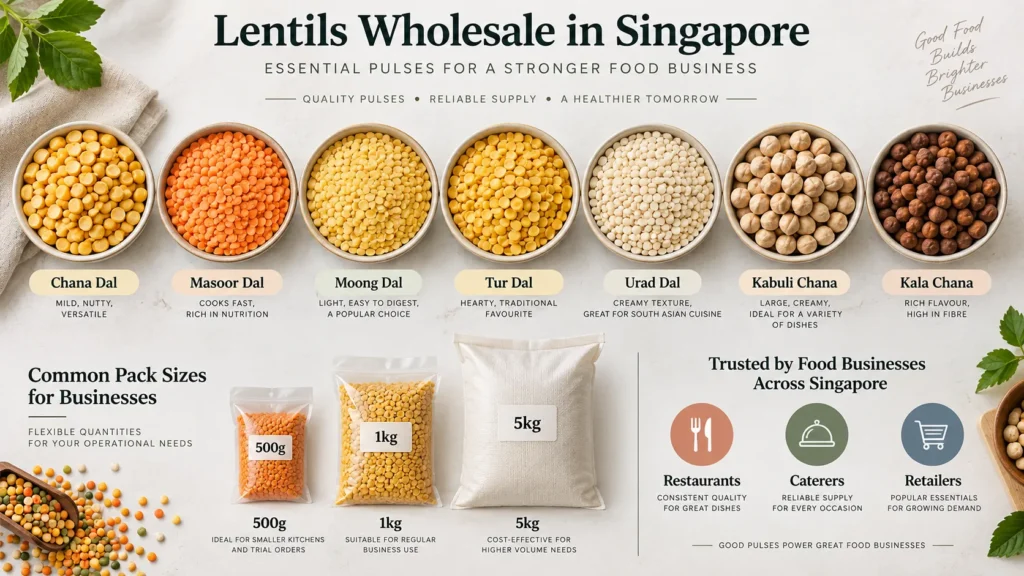
There is no single lentil that is suitable for every dish.
Commercial buyers should select varieties according to their menu, customer demand and expected usage.
Chana Dal
Chana dal is made from split Bengal gram and has a firm texture with a slightly nutty flavour.
It is commonly used in:
- Dal dishes
- Curries
- Vegetable preparations
- Snacks
- South Asian sweets
- Catering dishes
Chana dal tends to retain more texture after cooking than some softer lentils. This makes it useful when the individual pieces should remain identifiable rather than breaking down completely.
For restaurants serving a broad Indian menu, it can be a useful pantry staple.
View Chana Dal and Other Lentils
Masoor Dal
Masoor dal is a practical choice for many commercial kitchens because split masoor cooks relatively quickly and softens well.
It can be used for:
- Everyday dal
- Soups
- Curries
- Purees
- Vegetarian dishes
- Bulk catering preparations
For restaurants and caterers, preparation time matters. An ingredient that performs consistently from batch to batch can make kitchen planning easier, particularly during high-volume service.
Whole masoor provides a firmer texture and is useful when the dish requires more structure.
Moong Dal
Moong is available in different forms, including split and whole varieties.
It is commonly used for:
- Dal
- Khichdi
- Soups
- Light curries
- Vegetarian dishes
- Sprouted preparations
Split moong softens relatively quickly while whole moong provides more texture.
A restaurant may therefore stock more than one type depending on its menu.
Tur Dal or Toor Dal
Tur dal, also known as toor dal or arhar dal, is widely used in Indian cooking.
Common applications include:
- Sambar
- Dal tadka
- Gujarati dal
- South Indian dishes
- Vegetarian curries
For restaurants serving South Indian food or dal-based meals regularly, tur dal can become a high-frequency ingredient.
When an ingredient appears across several dishes, continuity of supply becomes particularly important.
Urad Dal
Urad is available in whole, split and skinned forms.
The different forms have distinct culinary uses.
Whole black urad is commonly associated with dishes such as dal makhani while other forms of urad are widely used in South Indian preparations.
Typical uses include:
- Dal makhani
- Idli
- Dosa
- Vada
- Tempering
- Curries
Businesses ordering urad should therefore specify the required form rather than simply requesting “urad dal”.
Kabuli Chana
Kabuli chana, commonly known as chickpeas or garbanzo beans, belongs to the wider pulse family and is often purchased alongside lentils.
It is widely used for:
- Chana masala
- Chole
- Curries
- Salads
- Hummus
- Catering dishes
Its use across Indian, Middle Eastern and other cuisines can make Kabuli chana a versatile product for both foodservice operators and retailers.
Kala Chana
Kala chana is smaller and darker than Kabuli chana. It generally has a firmer texture and distinctive flavour.
Typical applications include:
- Kala chana curry
- Chaat
- Salads
- Dry preparations
- Traditional Indian dishes
Retailers serving South Asian customers may find value in carrying both Kabuli chana and kala chana rather than treating chickpeas as a single category.
Choosing Lentils Based on Your Type of Business
A wholesale buyer should begin with the end use rather than the supplier catalogue.
Different businesses should approach lentil procurement differently.
Restaurants
Restaurants should identify the ingredients used repeatedly across their menu.
If masoor dal, tur dal or urad appears in several dishes, the restaurant can estimate regular weekly or monthly usage and plan replenishment accordingly.
Consistency is also important.
Different lentils can behave differently during cooking. Changes in the product supplied may affect:
- Cooking time
- Water absorption
- Texture
- Batch yield
- Kitchen preparation time
Restaurants should therefore assess both product suitability and supplier consistency.
Indian restaurants purchasing several pantry staples may also benefit from consolidating common ingredients with a single supplier.
Dashmesh carries lentils alongside rice, spices and other foodservice products.
Read the Indian Restaurant Grocery Supplier Singapore Guide
Caterers
Caterers often prepare food in considerably larger batches.
A small forecasting error becomes much more significant when preparing hundreds of portions.
Catering buyers should consider:
- Expected number of servings
- Quantity of dry lentils required per batch
- Cooking yield
- Event frequency
- Preparation time
- Available storage
- Delivery schedule
The goal should not simply be to buy the largest quantity available.
Instead, caterers should determine how much product they are likely to use within a reasonable period and build a purchasing schedule around that usage.
Grocery Retailers
Retailers have different considerations.
Rather than focusing on cooking yield, a retailer needs to consider:
- Customer demand
- Pack size
- Product variety
- Brand familiarity
- Shelf space
- Stock turnover
- Reordering frequency
A practical core lentils and pulses range might include:
- Chana dal
- Masoor dal
- Moong dal
- Tur dal
- Urad dal
- Kabuli chana
- Kala chana
- Black-eyed beans
- Kidney beans
The range can then be expanded according to customer demand.
Businesses selling prepacked foods should also ensure that applicable Singapore food labelling requirements are met.
Singapore Food Agency: Labelling Requirements for Food
Central Kitchens and Food Manufacturers
Higher-volume users should place even greater emphasis on repeatability.
Important considerations can include:
- Product specifications
- Consistent supply
- Pack size
- Storage requirements
- Lead times
- Delivery reliability
- Batch-to-batch consistency
At this scale, the lowest purchase price is not necessarily the most economical choice.
An inconsistent ingredient that disrupts production or creates additional preparation can result in costs elsewhere in the operation.
Choosing the Right Pack Size
Pack size should match actual consumption.
Dashmesh’s lentils catalogue includes products in formats such as 500g, 1kg and 5kg, depending on the individual product.
Browse Available Lentils and Pack Sizes
500g and 1kg Packs
Smaller packs can be suitable for:
- Grocery retailers
- Specialist food stores
- Convenience retailers
- Lower-volume food businesses
- Businesses testing a new product
For retailers, smaller packs may allow a broader range to be stocked without committing too much inventory to any single variety.
5kg Packs
Larger 5kg formats can be practical for:
- Restaurants
- Caterers
- Commercial kitchens
- Frequent users
They allow businesses to purchase more product while keeping individual bags relatively manageable for kitchen handling and storage.
Larger Purchasing Requirements
High-volume restaurants, caterers, central kitchens and manufacturers may require quantities beyond normal retail pack sizes.
Before increasing order volumes, businesses should determine:
- Monthly usage
- Available storage
- Product shelf life
- Reordering frequency
- Cash tied up in inventory
A larger order is not automatically a better order.
Buying excess stock simply to reduce the unit price can increase storage requirements and tie up working capital unnecessarily.
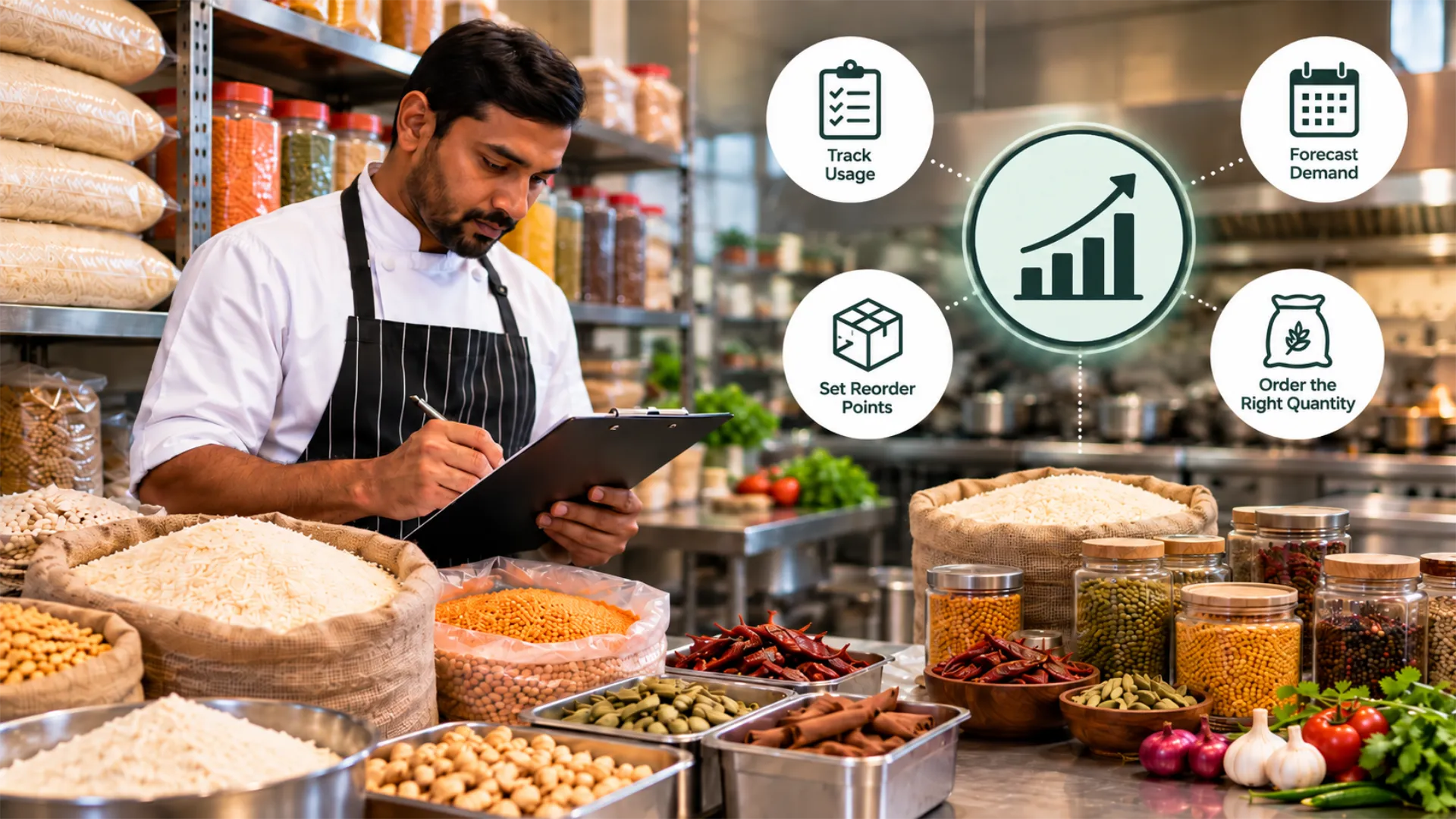
Calculate Your Lentil Usage Before Ordering
One of the simplest ways to improve wholesale purchasing is to calculate actual consumption.
For example, suppose a restaurant uses approximately 250 grams of dry dal per batch and prepares eight batches each day.
250g × 8 batches = 2kg per day
If the restaurant operates for 30 days:
2kg × 30 days = approximately 60kg per month
The restaurant now has a much more useful starting point for procurement.
It can then adjust this figure according to:
- Weekday and weekend demand
- Seasonal fluctuations
- Catering orders
- Festive periods
- Supplier delivery frequency
- Desired safety stock
The same process can be applied to chana dal, masoor dal, moong, tur dal and other pulses.
Read 10 Bulk Ordering Best Practices
7 Key Factors When Choosing a Lentil Supplier in Singapore
Wholesale pricing matters, but the cheapest quote does not automatically represent the best value for your business.
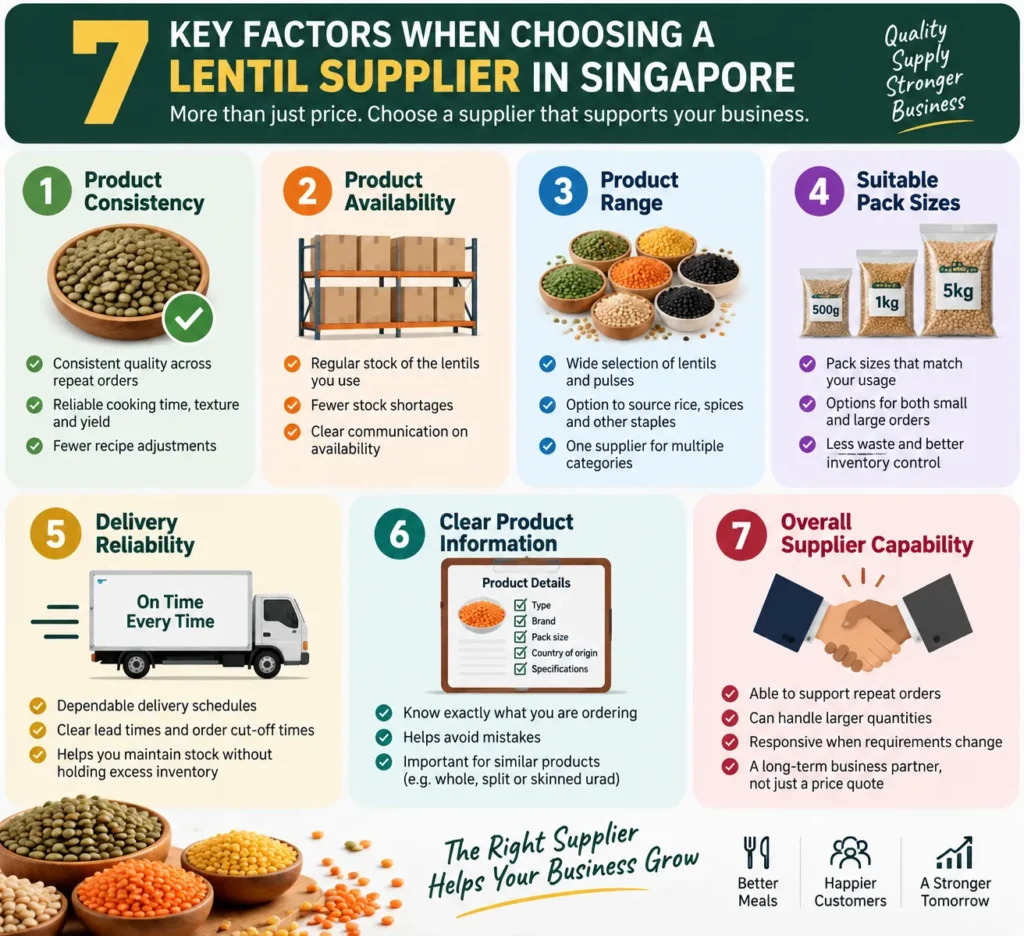
When comparing lentil suppliers in Singapore, assess these seven factors.
1. Product Consistency
A reliable supplier should be able to provide products that perform consistently across repeat orders.
For restaurants and caterers, inconsistency can affect:
- Cooking time
- Water absorption
- Texture
- Portion yield
- Preparation time
- Overall dish consistency
If a kitchen has to constantly adjust recipes because the product varies from one delivery to another, the apparent saving from a lower purchase price can quickly disappear.
What to check: Ask whether the same product specifications and brands can be supplied consistently for repeat orders.
2. Product Availability
A supplier needs to have the products your business depends on when you need them.
If tur dal, masoor dal or urad is used every day, repeated stock shortages can disrupt kitchen operations and force last-minute purchases from alternative suppliers.
Regular buyers should therefore ask:
- Which products are normally held in stock?
- How often is inventory replenished?
- How are temporary shortages communicated?
- Can regular quantities be reserved or planned in advance?
A competitive price means little if essential ingredients are frequently unavailable.
3. Product Range
Consider whether the supplier can support more than one part of your purchasing requirement.
A restaurant may regularly need:
- Lentils
- Rice
- Spices
- Flours
- Pickles and pastes
- Frozen products
- Dairy products
- Snacks
Being able to source several categories from the same supplier can reduce the number of orders, deliveries and supplier relationships your team needs to manage.
Explore Dashmesh Rice Products
4. Suitable Pack Sizes
The right pack size depends on how quickly your business uses the product.
A retailer may prefer smaller consumer-ready packs while a restaurant or caterer may require larger quantities.
When comparing suppliers, check whether pack sizes match your actual needs.
Consider:
- Average weekly consumption
- Storage capacity
- Handling convenience
- Stock turnover
- Frequency of delivery
Buying larger packs can reduce the cost per kilogram, but oversized quantities may create unnecessary storage and inventory costs.
5. Delivery Reliability
Reliable supply is especially important for businesses that operate with limited storage.
A good supplier should be able to provide clear information about:
- Delivery days
- Order cut-off times
- Expected lead times
- Minimum delivery quantities
- Procedures for urgent requirements
Regular deliveries can help businesses hold less excess inventory while still maintaining sufficient stock for daily operations.
For high-volume kitchens, dependable delivery can be just as important as product price.
6. Clear Product Information
Wholesale buyers should know exactly what they are ordering.
Important information may include:
- Product type
- Brand
- Pack size
- Quantity
- Country of origin where applicable
- Product specifications where relevant
Clear product information reduces ordering mistakes and helps businesses maintain consistency.
This is particularly useful when several similar products exist, such as whole urad, split urad and skinned urad.
7. Overall Supplier Capability
Finally, assess the supplier as a long-term business partner rather than simply comparing individual product prices.
Consider whether the supplier can:
- Support regular repeat orders
- Handle larger quantities when needed
- Supply multiple product categories
- Communicate clearly about stock availability
- Provide reliable delivery
- Respond when requirements change
For a restaurant, caterer or retailer, dependable supply can be worth more than a small difference in the price of an individual bag.
For a more complete supplier evaluation framework, see Dashmesh’s food supplier checklist.
Read the Food Supplier Checklist Singapore
Why Consolidating Food Purchases Can Help
A restaurant might purchase lentils from one supplier, rice from another, spices from a third and packaged goods from someone else.
There may be reasons to use specialist suppliers for certain products. However, too many suppliers can also create additional administrative work.
Each supplier relationship can involve:
- Purchase orders
- Delivery schedules
- Invoices
- Payments
- Stock checks
- Communications
- Replenishment requests
Consolidating suitable categories with a broader food supplier can make ordering easier to manage.
Dashmesh’s product range covers categories including lentils, rice, spices, flours, nuts, frozen and chilled products, dairy, pickles and pastes, snacks and ready-to-eat foods.
For a busy F&B business, reducing procurement complexity can be valuable in addition to securing competitive product prices.
Buying Locally or Importing Lentils Directly?
Larger businesses sometimes consider importing food products themselves.
However, commercial food imports into Singapore are regulated.
Businesses importing food for commercial sale must comply with Singapore Food Agency requirements, including relevant licensing or registration and import requirements.
SFA: What You Need to Know for Import of Food for Commercial Sale
Prepacked food sold in Singapore must also comply with applicable labelling requirements.
SFA: Food Labelling Requirements
For restaurants, smaller retailers and many other food businesses, purchasing through a Singapore-based wholesale supplier can therefore be simpler than managing the commercial import process independently.
Businesses considering direct imports should always check the latest SFA requirements applicable to the specific products they intend to import.
Questions to Ask Before Choosing a Lentil Supplier
Before establishing a regular supply arrangement, ask practical questions.
What lentils and pulses are regularly available?
Determine whether the supplier normally stocks the products your business uses most frequently.
What pack sizes are available?
Choose pack sizes according to actual usage rather than simply buying the largest available format.
Can larger quantities be arranged?
If your business has significant monthly requirements, ask how higher-volume orders are handled.
Is there a minimum order?
Understanding minimum quantities can help you decide whether the supplier is suitable for your operation.
What are the delivery arrangements?
Ask about delivery schedules, lead times and ordering procedures.
Can different product categories be combined?
Restaurants may be able to combine lentils with rice, spices and other pantry requirements.
How should regular orders be placed?
A clear ordering process becomes more important when products are replenished weekly or monthly.
These questions tell you far more about a potential supplier relationship than simply asking for the cheapest dal.
Lentils and Pulses Available from Dashmesh
Dashmesh’s lentil catalogue includes a range of lentils and pulses such as:
- Chana dal
- Kabuli chana
- Kala chana
- Masoor dal
- Whole masoor
- Moong dal
- Whole moong
- Urad varieties
- Black-eyed beans
Pack sizes vary by product.
Businesses can browse the current range and enquire about pricing based on their requirements.
View the Complete Dashmesh Lentils Range
Frequently Asked Questions About Lentils Wholesale in Singapore
Where can I buy lentils wholesale in Singapore?
Businesses can purchase lentils from food wholesalers and distributors serving restaurants, caterers, retailers and other commercial buyers. Dashmesh supplies a range of lentils and pulses in Singapore, including chana dal, masoor dal, moong dal, urad, chickpeas and other varieties.
Browse Dashmesh Lentils and Pulses
What types of lentils are available for wholesale purchase?
Common wholesale varieties include chana dal, masoor dal, moong dal, tur dal, urad dal, whole masoor, whole moong, Kabuli chana and kala chana.
The right choice depends on your menu, customer demand and how the product will be used.
What is the difference between lentils, dal and pulses?
Pulses are the broader category of dried edible seeds from legumes, including lentils, beans and chickpeas. Dal commonly refers to split pulses used in Indian and South Asian cooking and also to dishes prepared from them.
Which lentils are most suitable for restaurants?
This depends on the menu. Masoor dal is often used for quick-cooking dal and soups, tur dal is widely used for sambar and traditional dal dishes, urad is used in dishes such as dal makhani and South Indian preparations while chana dal works well in curries, snacks and vegetable dishes.
Restaurants serving several Indian dishes may need multiple varieties rather than relying on a single dal.
What pack size should a restaurant choose?
The ideal pack size depends on how much the restaurant uses each week or month.
Smaller operations may find 1kg or 5kg packs practical while higher-volume kitchens may require larger quantities. The best approach is to calculate actual consumption and match ordering quantities to storage space and delivery frequency.
Can retailers buy smaller packs of lentils for resale?
Yes. Retailers commonly stock smaller consumer-friendly packs. Dashmesh carries various lentils in pack sizes including 500g and 1kg for selected products.
Can I buy lentils together with rice and spices from the same supplier?
Yes. Consolidating several common pantry categories with one supplier may help reduce the number of purchase orders, deliveries and supplier relationships a business needs to manage.
Dashmesh supplies lentils alongside categories including rice and spices.
How do I calculate how much dal my restaurant needs?
Start by measuring how much dry dal is used per batch and multiply that by the number of batches prepared each day.
For example, a restaurant using 250g per batch for eight batches uses about 2kg per day. Over 30 days, that works out to approximately 60kg.
Add an appropriate stock buffer based on delivery frequency and expected changes in demand.
Should I choose a lentil supplier based only on price?
No. Price is important, but businesses should also consider the seven key factors covered in this guide: product consistency, availability, range, pack sizes, delivery reliability, product information and overall supplier capability.
What should I ask before choosing a wholesale lentil supplier?
Useful questions include:
- Which lentils are kept in regular stock?
- What pack sizes are available?
- Can larger quantities be arranged?
- Is there a minimum order?
- What are the delivery arrangements?
- Can lentils be combined with rice, spices and other products?
- How should repeat orders be placed?
These questions help determine whether the supplier can support your business consistently.
Do I need an import licence if I buy lentils from a Singapore wholesaler?
A business purchasing products locally from a Singapore wholesaler is different from importing the products itself. Businesses that import food directly for commercial sale must comply with applicable Singapore Food Agency requirements.
Businesses considering direct imports should check current SFA requirements.
SFA: Commercial Food Import Requirements
How can I enquire about wholesale lentil pricing?
Wholesale pricing can depend on the product, pack size and quantity required.
Businesses can contact Dashmesh directly to discuss their requirements and current product availability.
Looking for Lentils Wholesale in Singapore?
The right wholesale lentil supplier should do more than offer bags of dal at a competitive price.
For restaurants, caterers, retailers and other food businesses, the real value lies in securing:
- The right lentil varieties
- Suitable pack sizes
- Consistent products
- Reliable availability
- Convenient ordering
- Dependable supply
Start by identifying the lentils your business uses most frequently.
Then estimate your weekly or monthly consumption, determine the pack sizes that best fit your operation and build your ordering schedule around actual demand.
Dashmesh supplies lentils and pulses alongside a wider range of food products for restaurants, retailers, caterers and other businesses in Singapore.
Need lentils for your restaurant, retail store or food business?
Browse Dashmesh Lentils and Pulses
Or contact Dashmesh to discuss your wholesale requirements and current pricing.