
Introduction
Choosing a food supplier in Singapore is not just a pricing decision. For restaurants, caterers, grocery retailers, ship chandlers, supermarkets and community organisations, the right wholesale partner affects stock availability, menu consistency, customer satisfaction and day-to-day operations.
A supplier may look suitable on paper, but regular ordering often reveals the real test: Are deliveries reliable? Is product quality consistent? Are pack sizes suitable? Does the supplier communicate clearly when items are unavailable? Can they support repeat orders across rice, lentils, spices, nuts, dairy, frozen products, snacks and other essentials?
This food supplier checklist Singapore buyers can use is designed to help you compare suppliers before committing to regular wholesale orders. It is especially useful if you are reviewing a new wholesale partner in Singapore or comparing different food suppliers for restaurant, retail, foodservice or community supply needs.
For a broader overview of the local supplier landscape, you can also read Dashmesh’s guide to food suppliers in Singapore.
Why Food Supplier Evaluation Matters in Singapore
Singapore food businesses often operate with limited storage space, tight labour schedules and fast-moving customer demand. A restaurant may need consistent rice, dal, spices and dairy for daily service. A retailer may need shelf-ready grocery items with reliable packaging and replenishment. A ship chandler may need durable provisions for crew requirements. A community organisation may need bulk food supplies for events, kitchens or festive periods.
That is why a proper food supplier evaluation Singapore process matters. A strong supplier can help you reduce procurement friction, avoid stock disruptions and source products more efficiently. A weak supplier can create delays, inconsistent quality, last-minute substitutions and extra admin work for your team.
Before choosing a wholesale partner Singapore businesses can rely on, review these seven essential checks.
1. Check Regulatory Compliance and Food Safety Readiness
Compliance should be the first checkpoint. Depending on the type of food business, a supplier may need relevant licences, permits, registrations or food safety controls. This is especially important if the supplier imports, stores, processes, repacks or distributes food products.
For official guidance, buyers can refer to SFA’s page on licences, permits and registration for food import and export businesses. If the supplier manufactures, processes, packages or stores food, SFA also provides guidance on food manufacturing and storage licence or registration requirements.
When assessing a supplier, ask for the relevant information based on the product categories you are buying. For example, food importers, food manufacturers, food storage operators and cold-chain suppliers may have different requirements. Do not assume one licence covers every activity.
What to ask
Ask the supplier:
- What licences, registrations or permits are relevant to your operations?
- Do you import, store, process, repack or distribute the products?
- Can you provide product documentation when needed?
- How do you manage batch information and traceability?
- How are food safety issues, recalls or product complaints handled?
- Do you have food safety systems such as HACCP, ISO 22000 or other relevant controls?
- For halal products, are the relevant products or establishments halal-certified where required?
For businesses serving Muslim customers, halal requirements should be checked carefully. Do not rely only on verbal assurance. Ask for the appropriate halal documentation and confirm whether the certification applies to the product, brand, premises or process involved. For official information, refer to MUIS halal certification for businesses.
Why this matters
Regulatory issues can disrupt your own business even if the problem begins with the supplier. A good wholesale food supplier should be able to explain its compliance position clearly and provide the right documentation when requested. You can also use SFA’s track records for licensed food establishments as a useful reference point when checking supplier credibility.
2. Check Product Quality and Consistency
Quality is the heart of any food business. A low price is not helpful if the rice texture changes from batch to batch, spices lose aroma quickly or lentils cook inconsistently.
Before placing regular orders, test the products you expect to buy often. For restaurants and caterers, that means cooking with the products under normal operating conditions. For retailers, it means checking packaging, shelf life, customer appeal and stock presentation.
What to evaluate
Review:
- Product freshness
- Taste, aroma, texture and appearance
- Packaging condition
- Shelf life on delivery
- Brand consistency
- Batch consistency
- Storage condition on arrival
- Suitability for your menu, retail shelf or operational use
For Indian and South Asian food businesses, consistency is especially important across staples such as basmati rice, lentils, dal, spices, flour, nuts, dairy products, frozen items and ready-to-eat foods.
If rice is a major part of your menu or product range, review Dashmesh’s rice category and supporting guide on basmati rice wholesale in Singapore. If spices are central to your food preparation, you can also refer to the guide on choosing an Indian spices supplier in Singapore.
Practical tip
Start with a trial order before committing to a regular supply arrangement. Test the products in real use, not just by appearance. If your kitchen, retail team or customers notice a difference, raise it early and see how the supplier responds.
A reliable supplier should be open to feedback and able to advise on suitable products, brands or pack sizes.
3. Check Product Range and Category Depth
A supplier with only one strong category may be useful, but a broader wholesale partner can simplify procurement. If your business regularly orders multiple grocery categories, consider whether the supplier can support enough of your range to reduce vendor management.
A strong supplier should not only carry products. They should carry the right variety, pack sizes and alternatives for your business type.
You can review Dashmesh’s product range to see examples of food categories available for quotation.
Categories to review
Depending on your business, you may need:
- Rice and basmati rice
- Lentils, dal and pulses
- Whole spices, ground spices and masala mixes
- Nuts and dry foods
- Flours and staple pantry items
- Pickles, pastes and sauces
- Dairy and chilled products
- Frozen products
- Snacks and specialty items
- Ready-to-eat foods
- Bulk items for foodservice or retail
For restaurants, a broad product range can support menu consistency. For retailers, it can help keep shelves stocked with core Indian and Pakistani grocery items. For ship chandlers and community buyers, it can make bulk provisioning easier.
Why this matters
Using too many suppliers increases admin work, order tracking and delivery coordination. A supplier with strong category depth can become a more efficient procurement partner, especially when your business needs repeat orders across several product lines.
4. Check Pricing, Pack Sizes and Minimum Order Quantities
Price matters, but it should not be reviewed in isolation. A supplier with a lower unit price may not be the best choice if the pack size is unsuitable, delivery charges are unclear or minimum order quantities do not match your storage capacity.
For a fair comparison, ask for the full commercial picture.
What to compare
Check:
- Unit pricing
- Carton, bag or case sizes
- Minimum order quantities
- Delivery charges
- Payment terms
- Bulk order pricing
- Repeat order arrangements
- Price-change notice period
- Substitute product options
Restaurants and caterers should pay attention to operational usage. A 25kg bag or carton may be cost-effective only if the product moves fast enough. Retailers should consider shelf life, sell-through rate and display space.
If your business buys large quantities of rice, lentils, spices, snacks or pantry staples, review whether the supplier can support suitable pack sizes and regular replenishment. Dashmesh’s bulk items category is a useful internal page to link here.
Value, not just price
The cheapest supplier is not always the most cost-effective supplier. Late deliveries, inconsistent quality, short shelf life and unclear communication can increase hidden costs. A slightly higher price from a reliable wholesale partner may offer better value if it reduces waste, emergency purchases and procurement stress.
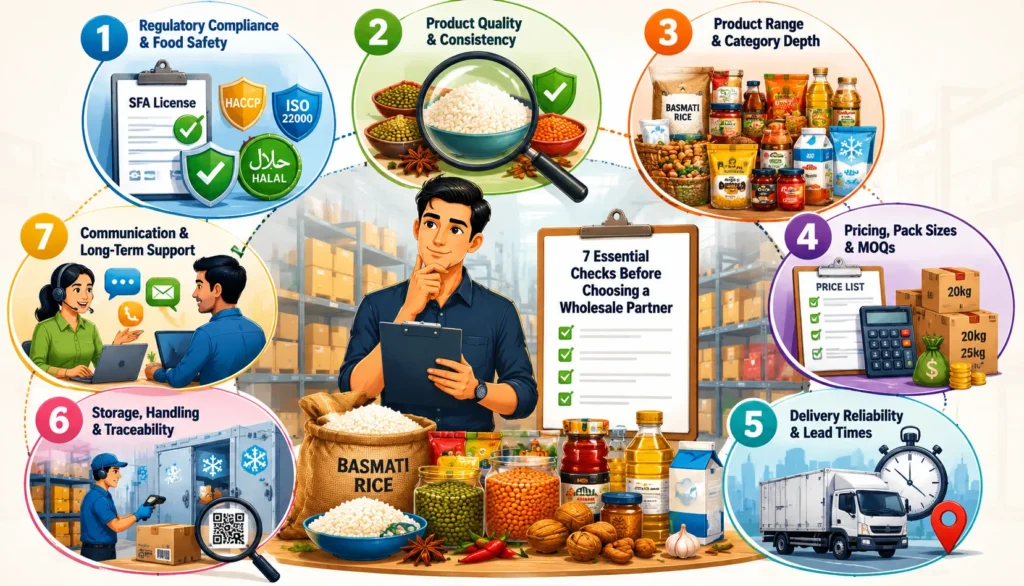
5. Check Delivery Reliability and Lead Times
A good product becomes a problem if it does not arrive when your team needs it. Delivery reliability is one of the most important parts of choosing a food supplier in Singapore.
Before committing, ask how the supplier manages normal orders, urgent orders and unavailable items.
Key delivery questions
Ask:
- What are the usual delivery days and time windows?
- What is the order cut-off time?
- Do you deliver to my location?
- Are there minimum orders for delivery?
- How are delays communicated?
- What happens if an item is out of stock?
- Can you support repeat delivery schedules?
- How do you handle chilled or frozen products?
- Can you support larger seasonal or festive orders?
For restaurants, late delivery can affect prep and service. For retailers, missed replenishment can lead to empty shelves. For community organisations, temples and clubs, poor delivery planning can affect event readiness.
Dashmesh’s Our Business page is a strong internal link here because it explains how the company supports restaurants, ship chandlers, wholesale buyers, supermarkets, e-commerce, retail customers and community organisations.
What good looks like
A reliable supplier should have clear order procedures, predictable lead times and proactive communication. They do not need to promise that every item is always available, but they should be transparent when there are supply issues and offer practical alternatives where possible.
6. Check Storage, Handling and Traceability
Food quality depends on how products are stored and handled before they reach you. This is important for dry goods, chilled products, frozen items and products with specific shelf-life requirements.
For dry goods such as rice, lentils, spices, nuts and flour, poor storage can affect freshness, texture and aroma. For chilled and frozen products, temperature control is even more critical.
SFA’s food safety tips are a useful external resource for general safe food practices. For supplier checks, combine that guidance with direct questions about storage, shelf-life monitoring and traceability.
What to ask
Ask the supplier:
- How are products stored before delivery?
- Are dry goods kept in suitable cool and dry conditions?
- How are chilled and frozen items handled?
- Do you follow first-in, first-out stock rotation?
- How do you monitor shelf life?
- Can products be traced by batch or supplier source?
- What is the process for damaged, expired or incorrect items?
For dry goods, you may also want to review category-specific buying guidance such as Dashmesh’s article on dry fruits and nuts wholesale in Singapore.
Why this matters
Traceability and proper handling help protect both your business and your customers. If there is a product recall, quality complaint or delivery issue, your supplier should be able to identify affected products and respond quickly.
This is especially important for businesses that order multiple categories from one supplier. You need confidence that every product type is handled appropriately, from shelf-stable pantry goods to chilled and frozen items.
7. Check Communication and Long-Term Support
The final check is the supplier relationship itself. Even with good products, a supplier can become difficult to work with if communication is slow, unclear or reactive.
A strong wholesale partner should help you plan better, not only take orders.
What to look for
Review whether the supplier provides:
- Clear quotation process
- Fast response to enquiries
- Product recommendations
- Updates on unavailable items
- Practical substitutes when suitable
- Support for repeat orders
- Help with seasonal or festive demand
- Clear handling of complaints or returns
- A contact person or responsive sales team
Good communication is especially important during peak periods such as festive seasons, event periods or high-demand restaurant weeks. A supplier that understands your buying pattern can help you plan stock earlier and avoid last-minute pressure.
Long-term fit
When choosing a wholesale partner in Singapore, think beyond the first order. Ask whether this supplier can grow with your business, support new product categories and keep communication consistent as your ordering needs increase.
If you are ready to discuss requirements, you can contact Dashmesh with your product categories, estimated quantities, preferred delivery schedule and pack-size needs.
Quick Food Supplier Checklist Singapore Buyers Can Use
Use this checklist before confirming a new supplier:
- Does the supplier have the relevant licences, registrations or documentation for its activities?
- Is product quality consistent across samples and repeat orders?
- Does the product range cover the categories your business needs?
- Are prices, pack sizes, payment terms and MOQs clear?
- Are delivery schedules, lead times and order cut-offs reliable?
- Are storage, handling and traceability processes suitable?
- Is communication responsive enough for a long-term partnership?
If several answers are unclear, continue comparing suppliers before committing to a regular order schedule.
Why Businesses Work with Dashmesh
Dashmesh supports businesses and organisations across Singapore with a wide range of Indian and Pakistani food products. Its product categories include essentials such as rice, pulses and nuts, spices, frozen and dairy products, snacks and specialty items.
For foodservice buyers, this supports regular procurement across everyday ingredients. For retailers and supermarkets, it provides access to recognised grocery categories and brands. For ship chandlers, community organisations and wholesale buyers, it supports practical bulk ordering across staple provisions.
Dashmesh works with different buyer segments including restaurants, wholesale partners, supermarkets, retail customers, e-commerce channels, ship chandlers, temples, clubs and community organisations.
If your business is reviewing food suppliers in Singapore, Dashmesh can support enquiries across core grocery categories, bulk ordering needs and repeat wholesale supply.
Request a Wholesale Supply Quote
If you are ready to compare suppliers, prepare your requirements before requesting a quote. This will help Dashmesh recommend suitable products and quantities for your business.
Include:
- Your business type
- Product categories required
- Estimated order quantities
- Preferred delivery schedule
- Pack-size or brand preferences
- Any seasonal or event-related requirements
- Contact details for follow-up
Contact Dashmesh to discuss your wholesale food supply requirements and request a quote for your business.
Frequently Asked Questions
What is a food supplier checklist Singapore businesses should use?
A food supplier checklist Singapore businesses can use should cover compliance, product quality, product range, pricing, pack sizes, delivery reliability, storage practices and communication. These checks help restaurants, retailers, caterers and other buyers compare suppliers before placing regular wholesale orders.
What should I check before choosing a wholesale partner in Singapore?
Check whether the supplier understands your business type, carries the product categories you need, offers suitable pack sizes, communicates clearly and can deliver reliably. You should also ask about relevant licences, storage practices, traceability and product documentation.
Why is product consistency important when choosing a food supplier?
Product consistency affects menu quality, customer satisfaction and inventory planning. Restaurants need ingredients that perform the same way across repeat orders, while retailers need products that arrive in good condition with suitable shelf life and packaging.
Is the cheapest food supplier always the best option?
Not always. Price is important, but delivery reliability, product quality, shelf life, communication and stock availability also affect total cost. A cheaper supplier may create hidden costs if your team needs emergency purchases or deals with frequent quality issues.
What product categories should I ask a wholesale grocery supplier about?
Depending on your business, ask about rice, lentils, dal, pulses, spices, nuts, dry foods, flours, dairy, frozen products, snacks, pickles, pastes, ready-to-eat foods and other pantry essentials. A broader product range can help simplify ordering.
How do I request a wholesale food supply quote?
Share your business type, required product categories, estimated order quantities, delivery needs, pack-size preferences and any brand requirements. The more specific your enquiry, the easier it is for the supplier to recommend suitable products and pricing.
Can Dashmesh support restaurants and wholesale buyers in Singapore?
Yes. Dashmesh supports restaurants, wholesale buyers, supermarkets, retailers, e-commerce channels, ship chandlers and community organisations with a broad range of Indian and Pakistani food products. Businesses can contact Dashmesh to discuss wholesale supply needs.