
Introduction
Frozen food wholesale in Singapore offers restaurants, caterers, supermarkets and grocery retailers a practical way to source products, expand their food offerings and manage operational costs. From traditional Indian flatbreads to convenient ready-to-cook snacks, frozen food products can help businesses reduce preparation time, maintain portion consistency and respond to changing customer demand.
However, purchasing frozen food in bulk requires more than finding competitive wholesale prices. Product quality, packaging sizes, storage conditions, shelf life and supplier reliability can all influence business performance.
Established in 1985, Dashmesh is a wholesale food supplier in Singapore specialising in Indian and Pakistani food products. Its frozen food portfolio includes traditional parathas, naans, chapatis and selected snacks from established brands such as NIK’s Cuisine and Amul.
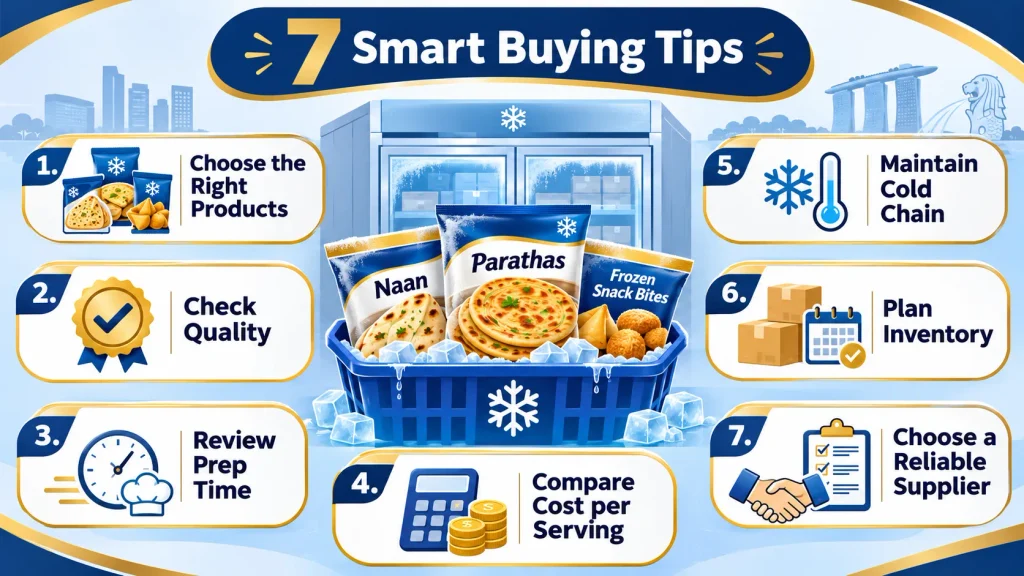
This guide explores seven practical buying tips to help food businesses make informed decisions when sourcing frozen products in Singapore.
Why Frozen Food Wholesale in Singapore Matters to Food Businesses
Food businesses in Singapore operate in a competitive environment where labour costs, preparation time, product consistency and inventory management influence profitability.
Frozen food provides businesses with additional options for managing these challenges while maintaining a diverse product selection.
For restaurants and caterers, ready-to-cook frozen products can reduce certain preparation requirements and support operations during periods of high demand.
For supermarkets and grocery retailers, packaged frozen food offers opportunities to cater to customers seeking convenient meal solutions.
The potential advantages include:
- Reduced food preparation time
- More consistent portion sizes
- Lower preparation labour requirements
- Greater flexibility in menu planning
- Improved inventory planning
- Reduced avoidable food wastage
- Wider product selections for retail customers
However, the benefits depend on selecting suitable products, maintaining appropriate storage conditions and purchasing quantities that reflect actual customer demand.
1. Choose the Right Frozen Food Products for Your Business
When sourcing frozen food wholesale in Singapore, the first consideration should be product suitability.
Different businesses have different purchasing requirements. Restaurants may prioritise products that complement existing menus, while grocery retailers may focus on brand recognition, packaging sizes and customer preferences.
Dashmesh offers a selection of Indian frozen food products suitable for different commercial applications.
Frozen Parathas
Parathas are versatile Indian flatbreads that can be served with curries, yoghurt, pickles and other accompaniments. Stuffed varieties can also be offered as breakfast items, light meals or takeaway options.
Dashmesh’s frozen parathas and naans collection includes the following products:
| Product | Listed pack size | Potential applications |
|---|---|---|
| NIK’s Aloo Paratha | 4 pieces | Breakfast and meal combinations |
| NIK’s Gobi Paratha | 4 pieces, 400g | Vegetarian menus |
| NIK’s Malabar Paratha | 6 pieces | South Indian cuisine |
| NIK’s Plain Paratha | 5 pieces | Curry accompaniments |
| NIK’s Mixed Veg Paratha | 4 pieces | Vegetarian meal options |
| NIK’s Onion Malabar Paratha | 4 pieces, 400g | Restaurants and takeaway outlets |
| NIK’s Paneer Paratha | 400g | Stuffed flatbread menus |
| Amul Cheese Onion Paratha | 500g | Cafés and grocery retail |
These varieties allow businesses to explore different menu combinations and retail product selections without preparing every type of flatbread from scratch.
Frozen Naans, Chapatis and Theplas
Naans and chapatis are widely used as accompaniments to Indian meals. Frozen alternatives can support commercial kitchens that require consistent portion sizes and convenient preparation.
Products available in Dashmesh’s online catalogue include:
| Product | Listed pack size |
|---|---|
| NIK’s Garlic Naan | 10 pieces, 850g |
| NIK’s Chapati | 10 pieces |
| NIK’s Methi Thepla | 400g |
Garlic naan is particularly suitable for North Indian meal combinations, while chapatis provide a versatile accompaniment to everyday dishes. Methi theplas offer another traditional flatbread option for restaurants and speciality grocery retailers.
Explore the NIK’s Cuisine product collection for more information.
Frozen Indian Snacks
Frozen snacks can help cafés, caterers, restaurants and grocery retailers diversify their food offerings.
Dashmesh’s catalogue includes products such as:
These products provide additional options for businesses exploring convenient snacks, appetisers and retail food selections.
When selecting frozen products, businesses should consider customer preferences, available freezer capacity, preparation requirements and expected sales volumes.
Current availability and wholesale carton quantities should be confirmed before placing orders.
2. Evaluate Frozen Food Quality and Product Consistency
Product quality is an essential consideration when choosing a frozen food supplier in Singapore.
For restaurants and catering businesses, inconsistent taste, texture or portion sizes can affect customer satisfaction and increase operating costs.
A competitively priced frozen product may not provide good value if it requires additional preparation or fails to meet customer expectations.
Conduct Product Trials
Before committing to bulk purchases, businesses should consider testing selected products using their existing kitchen equipment.
Important evaluation criteria include:
- Taste and flavour
- Texture after preparation
- Portion size and weight
- Cooking time
- Ingredient quality
- Appearance when served
- Compatibility with existing menu items
- Consistency across multiple servings
For example, a restaurant considering NIK’s Garlic Naan should assess how well the product complements its curry dishes and whether it maintains the desired texture after preparation.
Similarly, a catering business sourcing frozen Malabar parathas should determine whether the products can be prepared efficiently in batches.
Review Ingredients and Dietary Requirements
Businesses should also examine product ingredient declarations, allergen information and preparation instructions.
Frozen Indian flatbreads and snacks may contain wheat, milk, cheese or other ingredients that require attention when serving customers with dietary restrictions.
Where halal certification is important, businesses should verify the certification status of individual products before purchasing.
Dashmesh’s partner brands include NIK’s Cuisine and Amul, offering businesses a selection of products to evaluate according to their operational requirements.
3. Assess Preparation Time and Labour Efficiency
One reason businesses source frozen food wholesale in Singapore is to manage commercial kitchen workloads.
Preparing traditional Indian flatbreads from scratch may involve several stages, including ingredient measurement, dough preparation, resting, portioning, shaping and cooking.
Frozen ready-to-cook alternatives can reduce some of these preparation requirements.
Freshly Prepared vs Frozen Indian Flatbreads
| Consideration | Freshly prepared products | Frozen products |
|---|---|---|
| Preparation time | Generally longer | Fewer preparatory steps |
| Labour requirements | May require specialised skills | More standardised preparation |
| Portion consistency | Depends on kitchen procedures | Predetermined product sizes |
| Menu customisation | Greater flexibility | Based on available varieties |
| Storage | Ingredient and dough storage | Requires freezer storage |
| Peak-period preparation | May require additional staffing | Can support faster preparation |
The most suitable approach depends on the business model.
A restaurant may continue preparing its signature naans from scratch while using frozen parathas for selected breakfast dishes or takeaway meal combinations.
A catering business may incorporate frozen flatbreads into larger event menus where standardised portions and preparation efficiency are important.
This balanced approach allows businesses to retain their culinary identity while exploring opportunities to improve operational efficiency.
For additional cost management strategies, read Dashmesh’s guide to restaurant food costs.
4. Compare Wholesale Prices and Calculate Cost Per Serving
When purchasing frozen food in bulk, businesses should avoid comparing products solely by packet or carton prices.
Products may have different packaging sizes, weights, portion counts and preparation requirements.
For example, Dashmesh lists NIK’s Garlic Naan in a 10-piece, 850g pack and NIK’s Gobi Paratha in a four-piece, 400g pack.
These differences need to be considered when calculating menu prices, portion costs and purchasing quantities.
Calculate the Cost Per Serving
The basic formula is:
Cost per serving = Total purchase cost ÷ Number of usable servings
Consider the following hypothetical frozen paratha purchases:
| Cost consideration | Product A | Product B |
|---|---|---|
| Wholesale purchase cost | S$48.00 | S$55.00 |
| Number of parathas | 100 | 120 |
| Cost per paratha | S$0.48 | S$0.46 |
| Cost per two-piece serving | S$0.96 | S$0.92 |
Although Product B has a higher overall purchase price, it provides a slightly lower cost per serving.
These figures are illustrative and do not represent Dashmesh’s actual wholesale prices.
Consider the Total Cost of Frozen Food Procurement
Businesses should also account for:
- Delivery charges, where applicable
- Freezer storage costs
- Electricity consumption
- Cooking oil and preparation ingredients
- Labour requirements
- Damaged or unusable products
- Unsold or expired inventory
For supermarkets and grocery retailers, additional considerations include anticipated retail margins, freezer display space and product turnover.
Evaluating the total cost of procurement provides a more accurate assessment of product value than comparing wholesale prices alone.
5. Understand Frozen Food Storage and Cold Chain Requirements
Food safety is a critical consideration when sourcing frozen food wholesale in Singapore.
Unlike dry grocery products such as rice, flour and lentils, frozen food requires appropriate temperature-controlled storage and handling.
Poor temperature management can affect product quality, texture and food safety.
The Singapore Food Agency’s food safety guidance recommends maintaining freezers at −18°C or colder.
Businesses should also follow manufacturer-specific storage instructions and comply with applicable food safety requirements.
Frozen Food Receiving and Storage Checklist
When receiving frozen food deliveries, businesses should:
- Inspect packaging for damage and compromised seals.
- Check product temperatures against applicable receiving requirements.
- Examine products for signs of unintended thawing.
- Transfer products promptly into suitable freezer storage.
- Record relevant batch information and expiry dates.
- Monitor freezer temperatures regularly.
- Maintain sufficient airflow within freezers.
- Follow product-specific preparation and storage instructions.
Products intended to be cooked directly from frozen should be prepared according to their packaging instructions.
Where thawing is necessary, businesses should follow appropriate food safety procedures.
Further information is available through the Singapore Food Agency’s guidance on the responsibilities of food establishment operators.
Food Labelling Requirements for Retailers
Supermarkets and grocery retailers purchasing frozen products for resale should ensure that relevant food labelling requirements are met.
Depending on the product, labelling considerations may include:
- Product name and description
- Ingredient declarations
- Allergen information
- Net weight or quantity
- Applicable date markings
- Storage instructions
- Country of origin
- Importer or distributor information
Retailers can refer to the Singapore Food Agency’s food labelling requirements for official guidance.
Appropriate storage, handling and labelling practices help businesses protect customers and maintain product integrity.
6. Plan Bulk Frozen Food Orders Around Actual Demand
Buying frozen food wholesale in Singapore can provide operational advantages, but ordering excessive quantities may increase storage costs and create unnecessary inventory losses.
Unlike dry food products, frozen food occupies valuable temperature-controlled storage space.
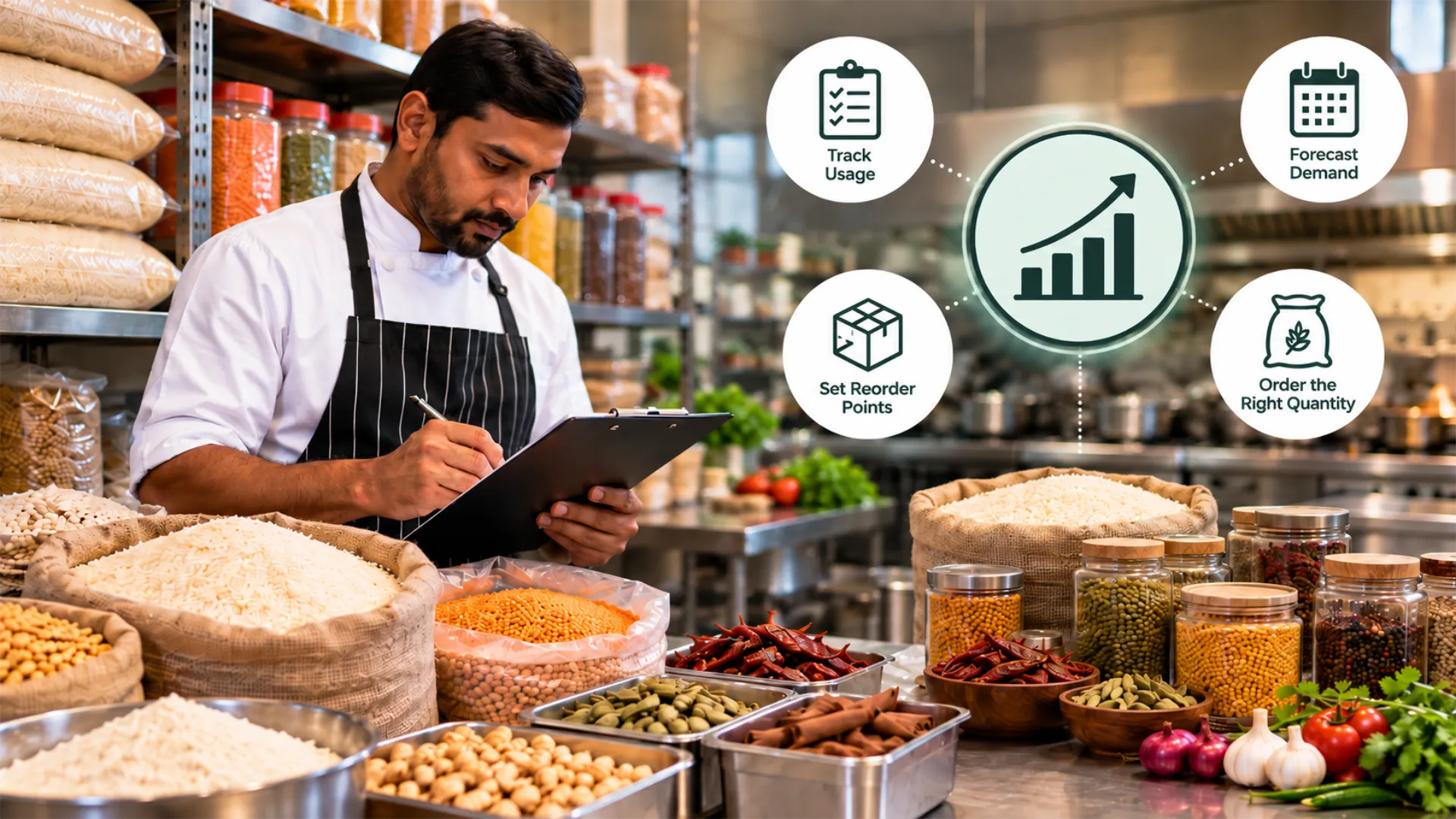
Businesses should therefore base purchasing decisions on actual consumption, projected demand, available freezer capacity and supplier lead times.
Calculate Weekly Frozen Food Requirements
Consider a restaurant serving parathas as part of its daily menu.
| Demand factor | Example |
|---|---|
| Average customers per day | 150 |
| Customers ordering parathas | 40% |
| Parathas per relevant customer | 2 |
| Estimated daily consumption | 120 pieces |
| Operating days per week | 7 |
| Estimated weekly consumption | 840 pieces |
| Illustrative 10% buffer stock | 84 pieces |
| Target weekly stock availability | 924 pieces |
In this example, the restaurant would aim to have access to approximately 924 parathas across the week, including buffer stock.
However, the actual order quantity should account for existing usable inventory and confirmed incoming deliveries.
Calculate the Required Order Quantity
Order quantity = Expected demand + Buffer stock − Usable inventory − Confirmed incoming stock
If the restaurant already has 200 usable parathas and expects another 100 pieces from a confirmed delivery, its additional purchasing requirement would be 624 pieces.
The final order quantity should be adjusted according to available packaging sizes, supplier arrangements and freezer capacity.
Improve Frozen Food Stock Rotation
The First Expired, First Out (FEFO) approach prioritises products with earlier expiry dates.
This is particularly useful when businesses receive multiple batches of the same frozen product with different remaining shelf lives.
Businesses should regularly review:
- Weekly product consumption
- Upcoming catering events
- Seasonal demand fluctuations
- Slow-moving products
- Product expiry dates
- Available freezer capacity
- Replenishment requirements
For more guidance on stock forecasting and purchasing decisions, read Dashmesh’s article on restaurant inventory management in Singapore.
7. Choose a Reliable Frozen Food Supplier in Singapore
Selecting a suitable frozen food distributor in Singapore is important for maintaining consistent business operations.
Wholesale buyers should assess more than product prices. Product suitability, availability, packaging options and storage arrangements are also important procurement considerations.
Frozen Food Supplier Evaluation Checklist
| Evaluation area | What to consider |
|---|---|
| Product range | Available frozen food categories and varieties |
| Brand selection | Established brands that meet business requirements |
| Packaging options | Pack sizes, carton quantities and portion counts |
| Product availability | Current availability and replenishment arrangements |
| Product shelf life | Remaining shelf life upon delivery |
| Cold chain | Appropriate storage and transportation arrangements |
| Wholesale pricing | Product quotations and applicable charges |
| Ordering requirements | Minimum quantities and delivery arrangements |
| Product information | Ingredients, allergens and applicable certifications |
| Customer support | Product enquiries and order coordination |
Businesses should clearly communicate their requirements when requesting quotations, particularly for regular restaurant operations, large catering events or retail promotions.
Dashmesh’s food supplier checklist for Singapore businesses provides a more comprehensive framework for evaluating potential wholesale suppliers.
Working with a supplier that offers multiple grocery categories can also simplify procurement by allowing businesses to source frozen products alongside rice, spices, lentils, flour and other food essentials.
Frozen Food Wholesale Solutions for Different Business Sectors
The requirements for frozen food procurement vary across restaurants, catering companies, supermarkets and wholesale distributors.
Restaurants and Hotels
Restaurants and hotel kitchens can incorporate selected frozen Indian flatbreads into existing menus to manage preparation time and expand their offerings.
Products such as garlic naan, aloo paratha and Malabar paratha may complement traditional Indian dishes while providing additional preparation flexibility.
Catering Businesses
Catering companies often need to prepare large volumes of food within specific timeframes.
Standardised frozen products can support portion planning and event preparation when suitable storage, transportation and cooking arrangements are available.
Supermarkets and Minimarts
Frozen Indian food products can complement existing retail selections of rice, flour, spices and packaged grocery items.
Retailers can develop a balanced assortment of traditional flatbreads and convenient snacks based on customer demand, product turnover and freezer capacity.
Cafés and Takeaway Outlets
Cafés and takeaway businesses may incorporate frozen stuffed parathas and selected snacks into breakfast menus, light meals and snack offerings.
These products can provide opportunities to expand menu variety without introducing unnecessarily complex preparation procedures.
Wholesale Distributors
Wholesale buyers supplying multiple business customers should consider product availability, brand preferences, storage requirements and suitable commercial purchasing arrangements.
Through its food import, export and distribution business, Dashmesh serves several commercial sectors, including restaurants, hotels, supermarkets, grocery retailers and wholesale customers.
Why Source Frozen Food Wholesale in Singapore from Dashmesh?
Established in 1985, Dashmesh has decades of experience in the distribution of Indian and Pakistani food products in Singapore.
Alongside its extensive range of rice, lentils, spices and grocery essentials, Dashmesh offers frozen Indian food products from established brands such as NIK’s Cuisine and Amul.
Businesses sourcing frozen food from Dashmesh can explore:
- Traditional Indian frozen flatbreads
- Stuffed and plain parathas
- Garlic naans and chapatis
- Methi theplas
- Selected frozen Indian snacks
- Products from established food brands
- Complementary dry grocery products
Dashmesh’s diverse product portfolio allows businesses to enquire about frozen products alongside other food procurement requirements.
For example, a restaurant sourcing frozen naans and parathas may also require wholesale Indian flour, rice, spices and ghee for restaurant cooking.
This provides an opportunity to coordinate purchasing requirements across multiple food categories.
Explore Dashmesh’s frozen parathas and naans catalogue to identify suitable products for your business.
Frequently Asked Questions
Where can I buy frozen food wholesale in Singapore?
Businesses can source frozen food from established wholesale suppliers and distributors such as Dashmesh. Dashmesh specialises in Indian and Pakistani food products and offers frozen parathas, naans, chapatis and selected snacks from brands including NIK’s Cuisine and Amul.
What types of frozen food does Dashmesh supply?
Dashmesh’s online catalogue includes frozen aloo parathas, gobi parathas, Malabar parathas, paneer parathas, garlic naans, chapatis and selected frozen snacks.
Businesses should enquire directly about current product availability and wholesale purchasing arrangements.
Does Dashmesh supply frozen food for restaurants?
Dashmesh serves restaurant and foodservice customers in Singapore. Its frozen Indian flatbreads and selected snacks provide product options for commercial kitchens looking to expand their menus or reduce certain preparation requirements.
Can supermarkets purchase frozen Indian food in bulk?
Supermarkets, minimarts and speciality grocery retailers can contact Dashmesh to discuss bulk purchasing requirements for packaged frozen Indian products.
Purchasing decisions should consider customer demand, product shelf life, labelling and available freezer space.
What temperature should frozen food be stored at?
The Singapore Food Agency recommends maintaining freezers at −18°C or colder. Businesses should also follow product-specific storage instructions and applicable food safety requirements.
Is buying frozen food wholesale more cost-effective?
Buying frozen food wholesale may provide opportunities to manage purchasing costs, preparation labour and product consistency.
However, the overall cost-effectiveness depends on purchase prices, storage costs, product turnover, preparation requirements and wastage.
How do I choose a reliable frozen food distributor in Singapore?
Evaluate the supplier’s product range, packaging options, pricing, product availability, shelf life, cold-chain arrangements and customer support.
Businesses should also consider conducting product trials before committing to larger purchases.
How can I request frozen food wholesale prices from Dashmesh?
Businesses can contact Dashmesh Singapore to enquire about current frozen food availability, wholesale quotations, packaging configurations and delivery arrangements.
Conclusion
Frozen food wholesale in Singapore provides restaurants, caterers, supermarkets and grocery retailers with opportunities to expand their food offerings, manage preparation requirements and improve procurement planning.
However, successful frozen food sourcing requires careful consideration of product quality, packaging sizes, cost per serving, storage conditions and supplier suitability.
By selecting appropriate products, maintaining effective stock management practices and evaluating total procurement costs, businesses can make more informed purchasing decisions.
With its established presence in Singapore’s wholesale food distribution sector, Dashmesh offers a selection of Indian frozen food products alongside a comprehensive range of grocery essentials.
Whether you are sourcing frozen parathas for your restaurant, naans for a catering event or packaged frozen snacks for your retail store, Dashmesh can assist with your product enquiries and wholesale purchasing requirements.
Looking for frozen food wholesale in Singapore?
Contact Dashmesh today to discuss your business requirements and request a wholesale quotation.