
Introduction
Choosing the right bulk rice supplier Singapore businesses can rely on is an important decision for restaurants, caterers, hotels, retailers, ship chandlers and foodservice operators.
Rice is not just a basic pantry item. For many food businesses, it is served every day, used across multiple dishes and ordered in large volumes. A small issue with rice quality, texture, delivery timing or stock availability can affect kitchen operations, customer satisfaction and food cost control.
For example, an Indian restaurant may need long-grain basmati rice for biryani and pulao. A South Indian eatery may need ponni rice for daily meals. A Thai, Malay or Asian food stall may prefer fragrant jasmine rice for rice sets and curries. A caterer may need reliable 25kg rice bags for buffet preparation, staff meals and event menus.
This guide explains how businesses can choose a bulk rice supplier in Singapore by looking at rice type, consistency, pack size, food safety, delivery reliability, storage support and long-term value.
For businesses that want to compare available options, Dashmesh Singapore carries a wide rice range suitable for restaurants, caterers, retailers and other foodservice buyers.
Why Bulk Rice Supply Matters for Food Businesses
Rice is one of the most frequently used ingredients in Singapore’s food industry. It appears in hawker meals, restaurant menus, catering trays, buffet spreads, packaged food, staff meals and home grocery shelves.
For businesses, rice buying is different from household grocery shopping. A home cook may buy a small pack based on taste or price. A food business must think about volume, repeat orders, cooking consistency, storage space, delivery timing and cost per serving.
When rice is sourced well, it helps a business maintain:
- consistent dish quality
- predictable food costs
- smoother kitchen planning
- fewer emergency purchases
- better inventory control
- less wastage from poor-quality grains
- stronger customer satisfaction
When rice supply is unreliable, the problems show up quickly. Kitchens may have to switch rice types, adjust recipes, delay preparation or buy emergency stock at higher prices. This is why choosing a reliable wholesale food supplier in Singapore is not just a purchasing task. It is part of operational planning.
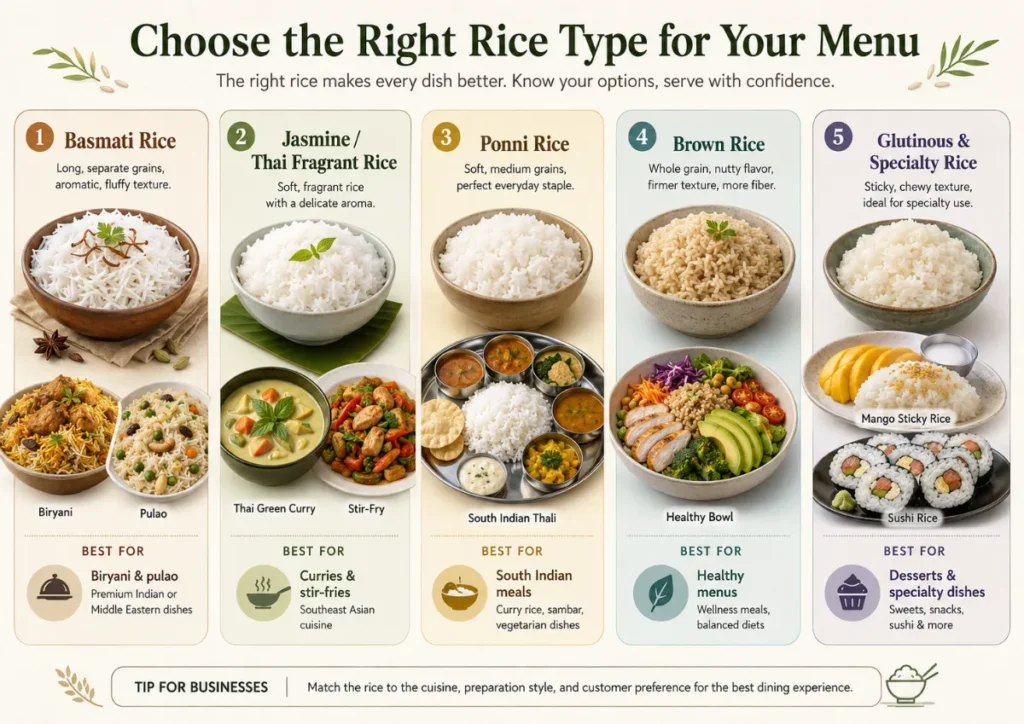
1. Choose the Right Rice Type for Your Menu
The first step is to match the rice type to the dishes your business serves. Different rice varieties behave differently when cooked. They vary in aroma, grain length, starch level, texture and how well they hold up during service.
Basmati Rice
Basmati rice is known for its long grains, aroma and fluffy cooked texture. It is commonly used for biryani, pulao, Middle Eastern rice dishes, Indian restaurant menus and premium buffet spreads.
For restaurants that serve biryani or rice-based Indian meals, basmati rice consistency is especially important. The grains should remain separate after cooking and should not become heavy or sticky.
For a deeper buying guide, read Dashmesh’s article on basmati rice wholesale Singapore. Businesses can also refer to APEDA’s official Basmati Rice overview for background on basmati rice characteristics and origin.
Jasmine and Thai Fragrant Rice
Jasmine rice and Thai fragrant rice are popular for Asian dishes because of their aroma and soft texture. They work well with curries, stir-fries, rice sets and everyday meals.
For food stalls, caterers and restaurants that serve Southeast Asian cuisine, fragrant white rice is often chosen because it pairs well with strong sauces and gravies. Businesses looking for larger formats can review Dashmesh’s rice product category to compare available rice types and pack sizes.
Ponni Rice
Ponni rice is commonly used in South Indian cooking. It is suitable for daily meals, vegetarian dishes, curry rice, thali-style service and other preparations where rice is served as a staple accompaniment.
Food businesses that serve South Indian meals often need ponni rice in larger bags because of daily usage volume.
Brown Rice and Healthier Options
Brown rice is often used by businesses that serve health-conscious customers, corporate catering menus, vegetarian meals or wellness-focused dishes. It has a firmer texture and requires different cooking times compared with white rice.
If your business offers healthier menu options, it is useful to work with a supplier that can support both regular white rice and healthier rice alternatives.
Glutinous Rice and Specialty Rice
Glutinous rice, sushi rice and other specialty rice types are more specific in use. They may be needed for desserts, snacks, Japanese dishes, festive items or special menu applications.
If these are not everyday items, check whether your supplier can provide them when needed instead of forcing you to work with too many separate suppliers.
2. Compare Pack Sizes and Ordering Volumes
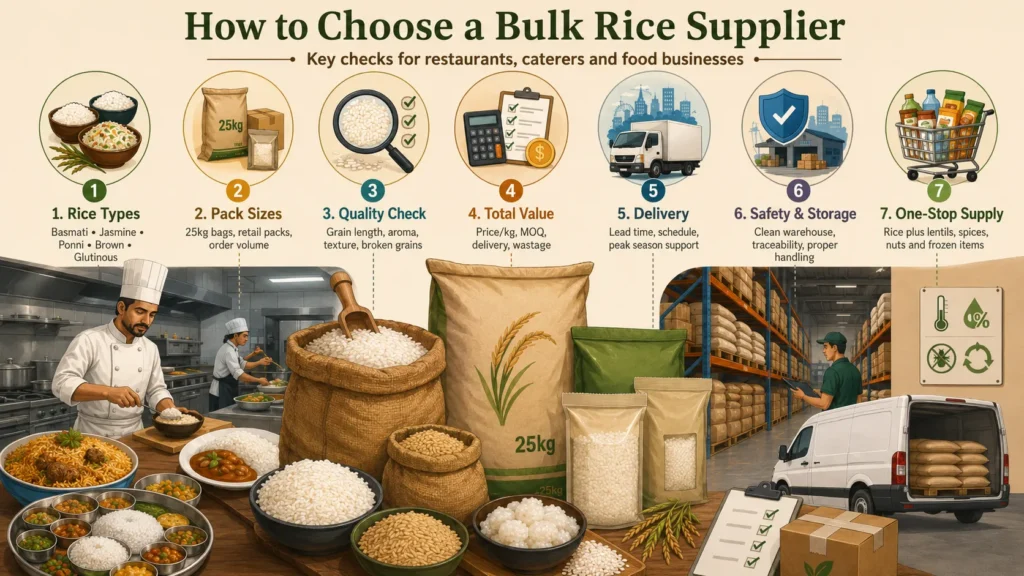
A good bulk rice supplier in Singapore should offer pack sizes that match your business usage.
For many restaurants, caterers and foodservice buyers, 25kg rice bags are practical because they support daily kitchen operations and reduce the need for frequent reordering. Smaller pack sizes may still be useful for retail shelves, premium varieties, specialty rice or businesses with lower storage capacity.
Before choosing a supplier, ask these questions:
- How much rice does your business use each week?
- Which rice types are used daily?
- Which rice types are used only for specific dishes?
- Do you need 25kg bags, carton packs, smaller retail packs or a mix?
- How much storage space do you have?
- How often can your supplier deliver?
Bulk buying can improve cost control, but only if the order size matches your real usage. Ordering too little can lead to frequent top-ups and emergency purchases. Ordering too much can create storage pressure, especially in Singapore’s humid environment.
For restaurants managing multiple dry goods, it may also help to review broader bulk ordering best practices before planning monthly procurement.
3. Check Rice Quality and Cooking Consistency
Rice quality affects both kitchen preparation and customer experience. When buying in bulk, consistency matters more than one-time quality.
A restaurant does not only need good rice once. It needs the same cooking results across repeated orders. If the rice changes from batch to batch, chefs may need to adjust water levels, soaking time, cooking method or portion planning.
When evaluating rice quality, look at:
- grain length and appearance
- aroma after cooking
- texture after cooking
- percentage of broken grains
- cleanliness and absence of foreign matter
- consistency across multiple deliveries
- suitability for your specific dishes
For basmati rice, long and separate grains may be important. For fragrant rice, aroma and softness may matter more. For ponni rice, daily cooking performance and portion consistency may be the priority.
A good practice is to test rice samples in your own kitchen before committing to regular bulk orders. Cook the rice using your usual equipment, portion size and service conditions. This gives a more accurate result than judging by appearance alone.
Businesses comparing suppliers can also use this food supplier checklist for Singapore to assess quality, service and reliability before making a decision.
4. Look Beyond Price Per Bag
Price is important, but the cheapest rice is not always the best value for a food business.
A lower-priced bag may create hidden costs if the grains break easily, cook unevenly, absorb too much or too little water, produce more wastage, or fail to meet customer expectations. On the other hand, a slightly higher-priced rice may be more cost-effective if it gives better yield, better texture and fewer complaints.
When comparing bulk rice suppliers, consider total value instead of only the quoted price. Look at:
- price per kilogram
- delivery charges
- minimum order quantity
- payment terms
- pack size options
- consistency of supply
- product replacement process
- response time when issues occur
- availability of other grocery items in the same order
For restaurants and caterers, the real question is not only “How much is one bag of rice?” The better question is “Does this rice help us serve consistent meals at a predictable cost?”
If rice is only one part of your procurement list, working with an Indian restaurant grocery supplier in Singapore can help simplify ordering across rice, dal, spices and other essentials.
5. Review Delivery Reliability
Delivery reliability is a major factor when choosing a bulk rice supplier in Singapore. Food businesses operate on tight schedules. Rice must arrive before preparation starts, not after the kitchen has already planned the day’s production.
A supplier should be able to support your ordering rhythm, whether you need weekly deliveries, regular top-ups or larger scheduled orders before festive periods and peak seasons.
Ask your supplier:
- What are the usual delivery lead times?
- Are there fixed delivery days?
- Can delivery be arranged for larger orders?
- What happens if an item is temporarily unavailable?
- Can the supplier support peak periods such as Deepavali, Ramadan, year-end events or large catering seasons?
- How are order changes handled?
Reliable delivery reduces stress for chefs, purchasing managers and operations teams. It also helps prevent last-minute substitutions that may affect food quality.
6. Check Food Safety, Storage and Supplier Compliance
Rice may be shelf-stable, but it still needs proper storage and handling. Singapore’s warm and humid climate makes storage practices important, especially for businesses buying in bulk.
A reliable supplier should be able to explain how rice is stored, handled and delivered. Important areas include warehouse cleanliness, pest control, stock rotation, packaging condition and traceability.
For businesses buying rice in large quantities, it is also important to work with suppliers who understand Singapore’s food import and wholesale requirements. According to the Singapore Food Agency, rice is a controlled item and a licence is required to import, re-export and carry out wholesale dealings in rice. Businesses can refer to SFA’s official Import Requirements for Food & Food Products for current information.
Good supplier practices include:
- proper warehouse storage
- clean and intact packaging
- clear product labelling
- traceable product sources
- proper stock rotation
- responsive handling of quality issues
- clear replacement or return process
Food safety and supplier reliability should not be treated as separate issues. Both affect your business continuity.
7. Choose a Supplier That Supports More Than One Product
Many food businesses prefer working with a supplier that can provide more than rice. This is especially useful for restaurants, caterers, hotels, ship chandlers, grocery retailers and community organisations that need regular supplies of multiple food categories.
A one-stop supplier can help simplify procurement by allowing businesses to order rice together with other essentials such as lentils, spices, nuts, chilled and frozen items, dairy products, snacks, pickles, pastes and ready-to-eat products.
This can reduce:
- the number of suppliers to manage
- time spent comparing quotations
- delivery coordination issues
- payment administration
- emergency sourcing
- communication gaps between teams
For restaurants and caterers, this can be especially helpful because rice is rarely ordered alone. It is often part of a wider monthly or weekly procurement cycle.
How Different Businesses Choose Bulk Rice
Different businesses have different rice-buying priorities.
Restaurants
Restaurants usually focus on taste, texture, dish suitability and reliable repeat supply. Indian restaurants may prioritise basmati rice, while South Indian restaurants may need ponni rice. Restaurants serving mixed Asian menus may require fragrant rice or multiple rice types.
Caterers
Caterers need rice that performs well in large batches. The rice should hold its texture during transport, buffet service and extended holding time. Bulk pack size, delivery reliability and consistent cooking yield are especially important.
Hotels and Banquet Kitchens
Hotels may require different grades of rice for staff meals, buffet service, banquets and specialty restaurants. They often need dependable supply, documentation, consistent quality and responsive account support.
Retailers and Mini-Marts
Retailers may need a mix of pack sizes and recognised brands. Shelf appeal, brand trust, price range and customer demand are important factors.
Ship Chandlers and Institutional Buyers
Ship chandlers and institutional buyers often need dependable supply, larger quantities, clear communication and predictable delivery arrangements. Product availability and supplier responsiveness can be just as important as price.
Common Mistakes When Buying Rice in Bulk
Food businesses often make mistakes when rice sourcing is treated as a simple price comparison. Some common mistakes include:
- choosing the cheapest option without testing cooking quality
- using the wrong rice type for the dish
- ordering too much without proper storage space
- relying on too many small suppliers
- failing to confirm delivery lead times
- not checking pack condition upon delivery
- ignoring broken grain percentage
- not having a backup plan for peak periods
- assuming all 25kg rice bags perform the same way
A better approach is to test, compare and document what works for your kitchen. Once the right rice is selected, keep ordering patterns consistent so your supplier can support your demand more effectively.
Why Dashmesh Is a Practical Choice for Bulk Rice Supply in Singapore
Dashmesh Singapore supports businesses that need reliable access to Indian, Pakistani and South Asian food products, including rice, lentils, spices, nuts, frozen items, dairy products, snacks and other grocery essentials.
For food businesses looking for a bulk rice supplier in Singapore, Dashmesh offers access to a wide rice range that includes basmati rice, ponni rice, Thai fragrant rice and other rice options suitable for restaurants, caterers, retailers and foodservice buyers.
Dashmesh also carries trusted rice brands and house brands, making it easier for businesses to compare rice types, pack sizes and product options based on actual menu needs.
Instead of treating rice as a standalone purchase, businesses can work with Dashmesh as part of a wider procurement approach. This helps buyers source rice together with other essential ingredients used in Indian, Pakistani and Asian cooking.
Practical Checklist Before Choosing a Bulk Rice Supplier
Before finalising a supplier, use this checklist:
- Does the supplier carry the rice types your menu needs?
- Are 25kg or other bulk pack sizes available?
- Can you test rice quality before regular ordering?
- Is the rice consistent across repeated deliveries?
- Are delivery schedules suitable for your kitchen or business?
- Are storage and handling standards clearly managed?
- Does the supplier understand Singapore’s food supply requirements?
- Can the supplier support peak periods and larger orders?
- Is pricing clear, including delivery and minimum order quantities?
- Can you source other grocery essentials from the same supplier?
If the answer to most of these questions is yes, the supplier is more likely to support your business beyond a one-time transaction.
Conclusion
Choosing a bulk rice supplier Singapore food businesses can depend on requires more than comparing prices. Rice affects menu quality, kitchen efficiency, portion control, customer satisfaction and procurement planning.
The right supplier should offer suitable rice varieties, reliable bulk pack sizes, consistent quality, proper storage, clear communication and dependable delivery. For restaurants, caterers, hotels, retailers and ship chandlers, this can make daily operations smoother and more predictable.
Dashmesh Singapore provides a practical sourcing option for businesses that need rice and other essential grocery products in one place. Whether your business uses basmati rice for biryani, ponni rice for daily meals, fragrant rice for Asian dishes or a mix of rice types across different menus, working with a reliable supplier helps protect both quality and continuity.
For bulk rice enquiries, contact Dashmesh Singapore to discuss product options, pack sizes and supply requirements.
Frequently Asked Questions About Bulk Rice Supplier Singapore
What should I look for in a bulk rice supplier in Singapore?
Look for rice variety, consistent product quality, suitable pack sizes, reliable delivery, proper storage standards, clear pricing and responsive customer support. For food businesses, the supplier should be able to support repeat orders, not just one-time purchases.
What rice types are commonly bought in bulk?
Common bulk rice types include basmati rice, ponni rice, jasmine rice, Thai fragrant rice, brown rice and glutinous rice. The best choice depends on your cuisine, cooking method and customer expectations.
Is 25kg rice suitable for restaurants and caterers?
Yes. Many restaurants, caterers and foodservice businesses use 25kg rice bags because they support regular kitchen usage and reduce frequent reordering. However, businesses should ensure they have proper storage space before buying in large volumes.
How do I test rice quality before buying in bulk?
Ask for samples where possible and cook the rice using your actual kitchen process. Check texture, aroma, grain separation, water absorption and how the rice performs during service.
Is basmati rice the best option for all food businesses?
No. Basmati rice is excellent for biryani, pulao and Indian or Middle Eastern dishes, but it may not be the best choice for every menu. Fragrant rice, ponni rice or other varieties may be more suitable depending on your cuisine.
Why is delivery reliability important for bulk rice orders?
Rice is a daily-use ingredient for many food businesses. Late or incomplete deliveries can disrupt kitchen preparation, force last-minute purchases and affect service quality.
Can I order rice together with other grocery products?
Yes. Working with a supplier that offers rice along with lentils, spices, nuts, frozen items, dairy products and other essentials can make procurement easier and reduce supplier management time.